Ever feel like the latest AI models are incredibly smart but just a bit too slow or expensive for what you need? You’re not alone. For businesses looking to use AI on a large scale, speed and cost are often the biggest hurdles. Powerful AI models offer amazing capabilities, but their demand for computing power can lead to delays and hefty bills.
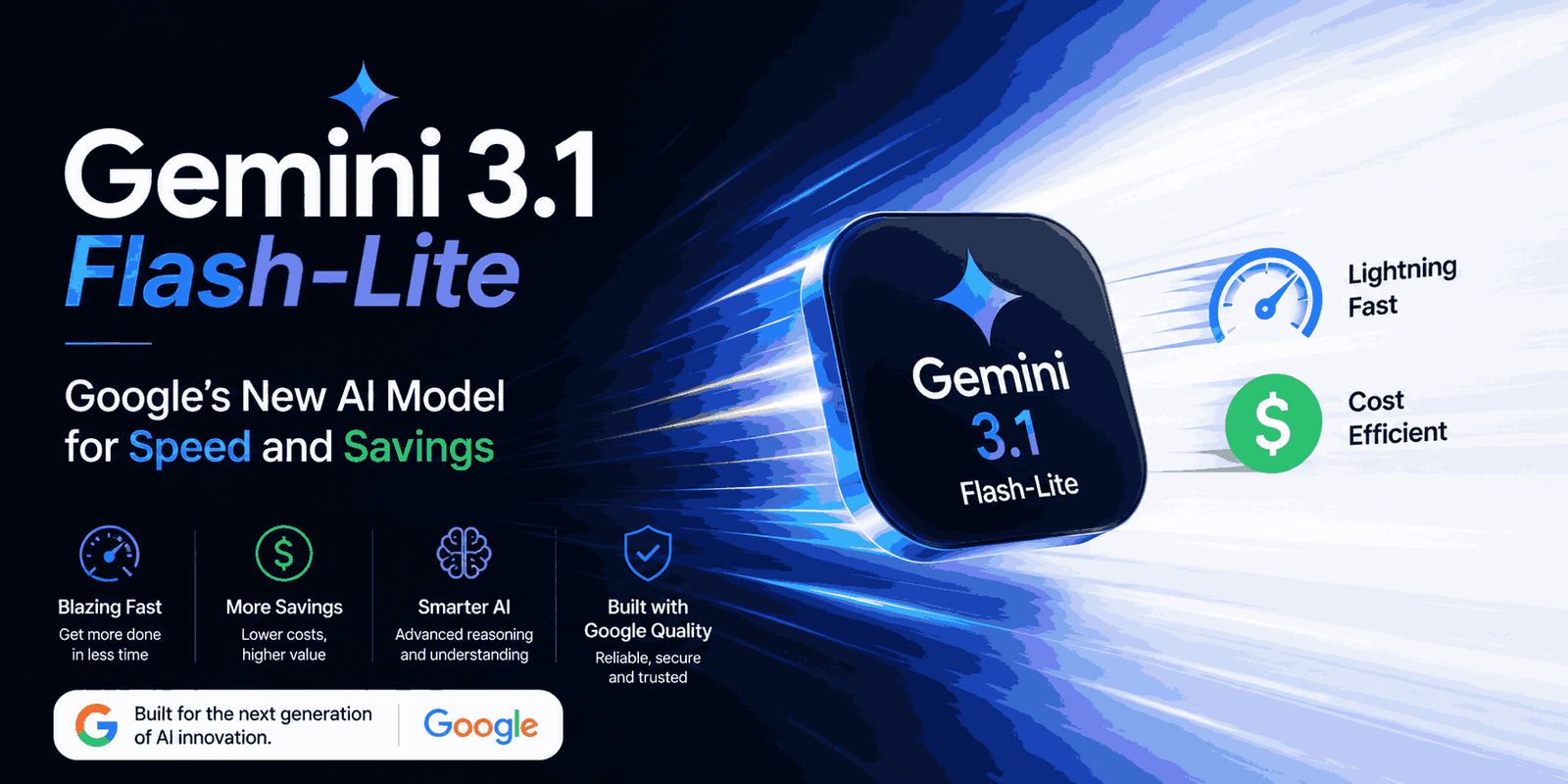
That’s why Google’s latest news is such a game-changer. On May 8, 2026, Google officially released Gemini 3.1 Flash-Lite, making it generally available. This isn’t just a minor update; it’s a smart move to give us an AI model that’s not only intelligent but also incredibly fast and budget-friendly.
If you’re building apps that need instant responses, handle huge amounts of data, or simply want to cut down your AI costs, Gemini 3.1 Flash-Lite might be exactly what you’ve been waiting for. Let’s explore what this new model offers and how it’s already making a difference for developers and businesses.
What Exactly Is Gemini 3.1 Flash-Lite?
Simply put, Gemini 3.1 Flash-Lite is Google’s quickest and most cost-effective model in the Gemini 3 family. Think of it as the agile, budget-friendly sibling, specifically designed for tasks that need super-low latency and high throughput. And it does this without sacrificing essential intelligence.
The problem it solves is a common one: many AI applications, especially when scaled up, become too expensive or too slow for real-time use. Flash-Lite steps in with a great solution, finding the sweet spot between intelligence, speed, and cost. This makes advanced AI more accessible for a wider range of production environments. Developers and businesses are finding it especially accurate for “agentic tasks” – these are scenarios where the AI needs to make decisions, use tools, or manage complex workflows. All this, while keeping costs low for automated systems.
Key Features That Make Flash-Lite Stand Out
Gemini 3.1 Flash-Lite isn’t just a small improvement. It comes with specific features built for top performance and efficiency:
- Ultra-Low Latency: This model is designed for applications where every millisecond truly counts. It gives quick responses, making real-time interactions smooth and effective.
- Handles High-Volume Tasks: Whether you’re sifting through millions of customer questions or analyzing huge datasets, Flash-Lite can easily manage massive amounts of interactions.
- Unmatched Cost-Efficiency: Google built this model to be budget-friendly. This means businesses can run extensive AI operations without spending a fortune. For example, some users have reported roughly 60% lower costs compared to similar “thinking-tier” models using the same mix of tokens.
- Fast, Iterative, and Scalable: It’s made for quick development cycles and can grow with your demands, making it a flexible choice for evolving applications.
- Precision for Agentic Tasks: Flash-Lite excels at complex decision-making, calling tools, and coordinating different AI components. This is crucial for building advanced AI agents.
- Multimodal Capabilities: The model can process and analyze various types of data, including text and images. This allows for richer, more dynamic applications, especially in creative fields.
Real-World Use Cases: Where Flash-Lite Shines
Many companies are already putting Gemini 3.1 Flash-Lite to work. It’s proving its worth across various industries.
Software Development and Engineering
For engineering teams, a speedy AI assistant can be the key to productivity. JetBrains, a well-known name in developer tools, has seen big improvements. According to Vladislav Tankov, Director of AI at JetBrains, “Integrating Gemini 3.1 Flash-Lite has transformed the responsiveness of our IDE AI assistant & Junie agent. The balance of high intelligence and minimal latency makes it the perfect model for real-time developer support.” This means smoother complex code completion, seamless user experience design, and more responsive tools for developers.
Customer Experience and High-Volume Service
Customer service often struggles to balance quality and cost when handling millions of interactions. Gladly, a company that manages customer service for major retail brands, uses Flash-Lite for its text-channel AI agent. By doing so, they achieved roughly 60% lower costs than comparable “thinking-tier” models with the same token mix. This model handles millions of customer-facing calls every week across platforms like SMS, WhatsApp, and Instagram. It powers every step of their agent’s work, from choosing tools to escalating to human agents. It maintains a p95 latency of about 1.8 seconds for generating full replies and under a second for p95 classifiers and tool calls, along with an impressive ~99.6% success rate under heavy concurrent load.
Creative Pipelines and Gaming
In creative and gaming industries, multimodal AI and low latency are essential for engagement and content creation.
- Astrocade lets users create games just by describing them in natural language. They integrated Flash-Lite to manage a growing global user base, performing multimodal safety checks (text and images) for every incoming game request. It also helps translate comments for players worldwide and refines prompts for generating high-quality thumbnails.
- Creative platform krea.ai uses Flash-Lite as a prompt enhancer in its Nodes tool. It takes a user’s rough idea and expands it into detailed prompts for image generation. They say it offers a level of detail that is “weirdly creative” for its price, making sophisticated prompt engineering more accessible and reliable.
Financial Services and Data Operations
Accuracy and efficiency are incredibly important in finance. Gemini 3.1 Flash-Lite provides financial analysts and product managers with the ideal combination of intelligence, low latency, and cost-effectiveness for modeling and sensitive applications.
- OffDeal uses Flash-Lite to power “Archie,” an AI agent for investment bankers. Archie provides real-time research, data lookups, and task execution during Zoom calls, bringing up financial details instantly. OffDeal also uses Flash-Lite as a triage layer for email traffic, figuring out which other AI agents to activate based on the message’s content.
- For Ramp, a financial operations platform, Flash-Lite is a key part of their high-volume, latency-sensitive workflows. Anton Biryukov, Applied AI Engineer at Ramp, stated, “Gemini is a core part of the model stack we use across applications at Ramp… Gemini 3.1 Flash-Lite has been especially valuable, powering many of our highest-volume, latency-sensitive features without compromising on quality.”
- Market intelligence platform AlphaSense also uses Flash-Lite to deliver data insights. Chris Ackerson, Senior Vice President of Product at AlphaSense, noted that the model “provides great balance of speed, cost and performance, allowing AlphaSense to scale our advanced data processing and deliver high-quality intelligence across every layer of our data stack.”
Why This Matters for Businesses and Creators
The general availability of Gemini 3.1 Flash-Lite has huge implications for how businesses and creators will use AI. This model isn’t just about faster calculations; it’s about opening up new possibilities for automation and efficiency.
For businesses, it means:
- Increased Productivity: Real-time AI assistance in coding, customer service, and financial analysis speeds up daily tasks.
- Significant Cost Savings: The reported 60% lower costs for high-volume tasks can free up massive budget for other areas, making advanced AI Automation Tools more achievable.
- Enhanced Customer Experience: Faster, more accurate AI agents lead to happier customers and more streamlined support operations.
- New Revenue Streams: Creators can develop more dynamic and personalized experiences, like in gaming, potentially opening up new ways to How to Make Money Using AI.
- Scalability: Enterprises can expand their AI projects without worrying about skyrocketing costs, allowing for growth in complex areas like AI Side Hustles based on innovative AI solutions.
This model helps bridge the gap between powerful AI capabilities and practical, affordable deployment. It makes sophisticated AI a reality for more use cases than ever before.
Who Should Use This?
Gemini 3.1 Flash-Lite is designed with a specific group of users and applications in mind:
- Developers: Especially those building real-time applications, AI agents, or needing instant feedback in coding environments.
- Enterprises: Companies in customer service, finance, and large-scale data operations that need high throughput and cost-efficiency.
- Businesses focused on High-Volume Automation: If your operations involve processing millions of interactions or running complex automated systems, Flash-Lite is for you.
- AI Enthusiasts: Anyone interested in exploring the cutting edge of efficient and powerful AI models.
- Freelancers & Agencies: Those building custom AI solutions for clients who need a good balance of performance and cost.
- Creative Platforms & Gaming Studios: Companies looking to integrate multimodal AI for generating content, personalization, or safety checks.
While it’s not a direct competitor to general-purpose chatbots, understanding its strengths can help you compare ChatGPT vs Gemini for specific business needs.
Pros and Cons of Gemini 3.1 Flash-Lite
Like any powerful tool, Flash-Lite has its strengths and limitations.
Pros:
- Exceptional Speed: Built for ultra-low latency, ensuring super-fast responses.
- Cost-Effective: Significantly cuts down operational costs for high-volume AI tasks.
- High Performance at Scale: Handles massive workloads with a high success rate.
- Precision for Agentic Workflows: Excellent at calling tools, orchestrating tasks, and making decisions for AI agents.
- Multimodal Capabilities: Can process both text and images, making applications more versatile.
- Scalable: Designed to grow easily with your application’s needs.
Cons:
- Enterprise-Focused: While powerful, its main benefits are geared towards large-scale, specific business and developer uses. It might not be the go-to for simple personal projects.
- Requires Technical Integration: This isn’t a simple plug-and-play tool for end-users; developers need to integrate it into their systems.
- “Lite” Designation: While intelligent for its purpose, it’s optimized for speed and cost. This means it might not offer the absolute deepest reasoning for every extremely complex task compared to more computationally intensive “Pro” models. Users should check if its intelligence is enough for their most demanding reasoning needs.
Alternatives to Consider
When you’re looking at AI models, it’s always smart to know your options. If you’re considering Gemini 3.1 Flash-Lite, other Google models are worth a look:
- Gemini 3.1 Pro: This offers more advanced reasoning and capabilities, often a better fit for tasks that need a deeper understanding and have fewer strict latency requirements.
- Gemini 3.1 Flash: The full Flash model is still a very efficient option. Flash-Lite is simply the even more optimized version for extreme sensitivity to cost and latency.
Beyond Google, the wider AI world includes models from OpenAI (like those often used in ChatGPT vs Gemini comparisons), Anthropic, and other big players. The best choice always comes down to your project’s specific needs for intelligence, speed, cost, and the ecosystem you’re already working within.
Beginner Tips for Getting Started with Flash-Lite
If you’re new to high-performance AI models, jumping into Gemini 3.1 Flash-Lite might seem a bit much. But it doesn’t have to be! Here are some practical tips to help you get started:
- Start with the Official Docs: Google Cloud’s documentation for Gemini 3.1 Flash-Lite is your best resource. It offers detailed guides on integration, API usage, and best practices.
- Understand Your Needs: Before you even write a line of code, clearly define what “ultra-low latency” and “cost-efficiency” mean for your specific project. This will help you measure success and optimize correctly.
- Experiment with Simple Agentic Tasks: Begin with straightforward tasks like basic tool calls or simple data classifications. This helps you get a feel for the model’s precision and how to manage its responses effectively.
- Leverage Google Cloud Resources: Explore the Google Cloud console, tutorials, and community forums. You’ll often find examples and shared experiences that can speed up your learning.
- Focus on Automation: Given its strengths, think about where Flash-Lite can automate repetitive, high-volume tasks in your current workflows. This is where you’ll see the quickest return on investment. If you’re looking for general advice on Best Free AI Tools to start with, this might not be it, but it’s a powerful entry point for serious development.
- Monitor Costs: Always keep an eye on your usage and the pricing structure. Flash-Lite is cost-efficient, but large-scale deployment still needs careful management.
FAQ Section
Q1: What is Gemini 3.1 Flash-Lite?
A1: Gemini 3.1 Flash-Lite is Google’s newest and most cost-efficient model in the Gemini 3 series. It’s built for ultra-low latency, high-volume tasks, and precise performance in agentic workflows.
Q2: How does Flash-Lite compare to other Gemini models like Pro or Flash?
A2: Flash-Lite is optimized for extreme speed and cost-efficiency, making it ideal for tasks where these factors are critical. While other Gemini models like Pro offer deeper reasoning for more complex tasks, Flash-Lite provides a specific balance of intelligence, speed, and cost for demanding production deployments.
Q3: What are the main benefits of using Gemini 3.1 Flash-Lite?
A3: Key benefits include ultra-low latency responses, significant cost reductions for high-volume operations (e.g., Gladly achieved 60% lower costs), precision for agentic tasks, and multimodal capabilities for processing various data types.
Q4: Which industries can benefit most from Gemini 3.1 Flash-Lite?
A4: Industries that can benefit significantly include software development (for real-time coding assistants), customer experience (for high-volume AI agents), creative and gaming (for multimodal content generation and safety checks), and financial services (for real-time data lookups and automated operations).
Q5: How can developers get started with Gemini 3.1 Flash-Lite?
A5: Developers can begin by reading the official documentation for Gemini 3.1 Flash-Lite on Google Cloud, exploring its pricing structure, and learning about the Gemini Enterprise Agent Platform. Experimenting with simple agentic tasks and leveraging Google Cloud’s resources are also great starting points.
Final Thoughts
The launch of Gemini 3.1 Flash-Lite marks an important moment in making advanced AI more practical and affordable for real-world use. By focusing on ultra-low latency and cost-efficiency, Google is empowering developers and businesses to build sophisticated, scalable solutions that were previously out of reach due to performance or budget limits.
Whether you’re looking to boost developer productivity, streamline customer service, innovate in creative fields, or optimize financial operations, Flash-Lite offers a compelling mix of intelligence and efficiency. It’s a clear reminder that the future of AI isn’t just about raw power; it’s about smart, sustainable implementation.
Want more AI tools, AI blogging tips, and AI money-making guides? Visit MakeDigitalProfits.com