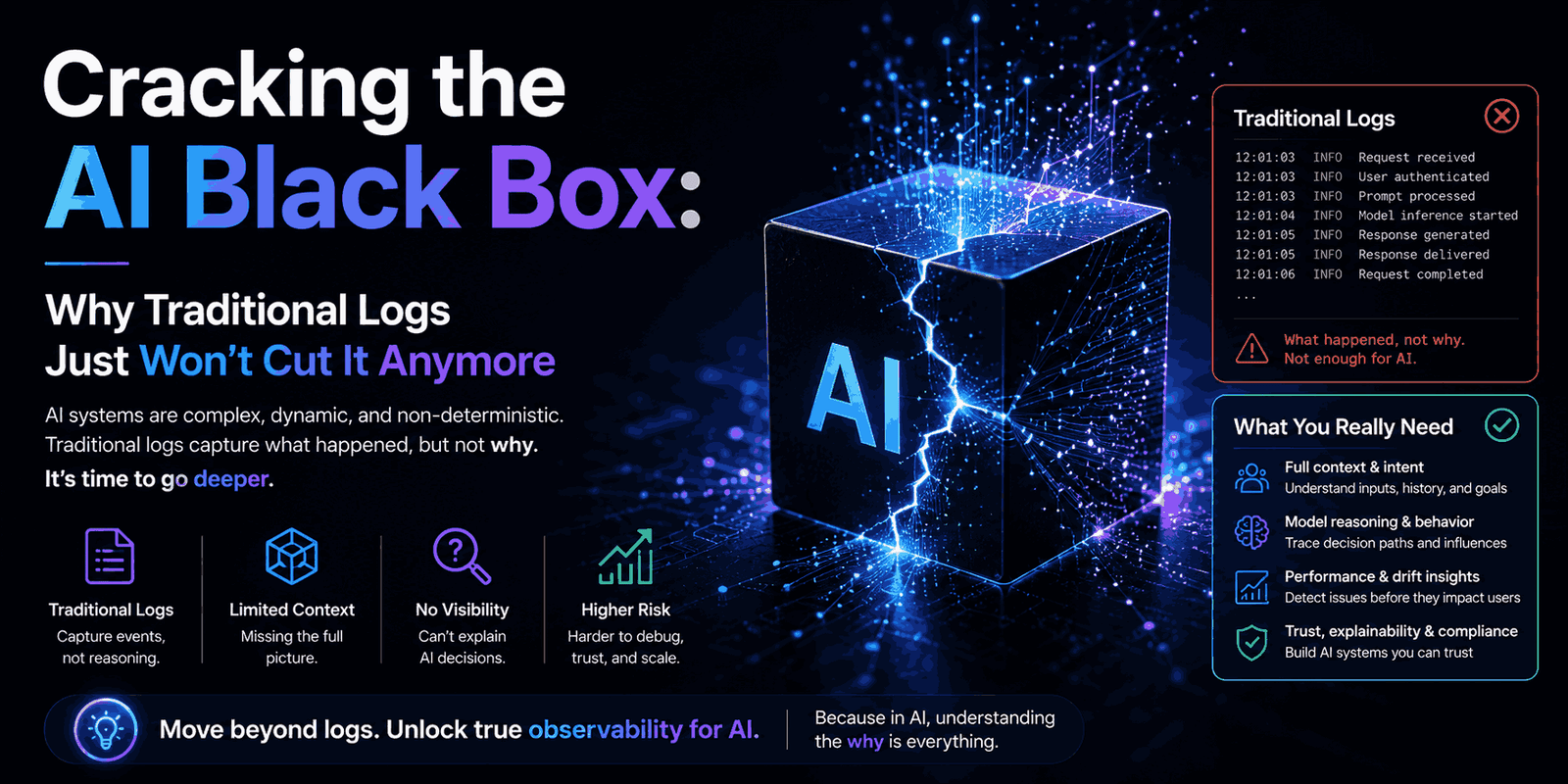
Artificial Intelligence is zooming forward, changing how we do pretty much everything. As AI systems get smarter and more independent, businesses and developers are running into a new, tricky problem: AI system observability challenges.
The old-school monitoring tools, the ones we’ve relied on for decades in software development, simply aren’t enough to tell us what’s really happening inside our intelligent systems. If you’re still just looking at logs to understand your AI, you’re likely missing a huge part of the picture – or worse, getting completely misled.
Let’s dive into why AI needs a fresh look at observability and what that new approach actually entails.
The Game Has Changed: Why Old Observability Fails AI
For years, watching how software behaved meant checking things like logs, traces, and basic infrastructure metrics. These methods work great for predictable software – programs that do the exact same thing every time given the same input. You can easily follow every step and understand every decision.
But today’s AI systems, especially advanced AI agents, are different. They’re often unpredictable. They learn, adapt, store memories, and talk to other tools. This makes their behavior far less straightforward. Because of this fundamental difference, simply logging what happened isn’t enough to explain why it happened.
Developers and operators are increasingly finding themselves asking tough questions:
- Why did our AI choose that specific option?
- What made the AI’s behavior suddenly change?
- Which part of its internal reasoning led to this particular outcome or failure?
When you can’t get clear answers, you end up with what many call a “black box operations” problem. It means even the people who built the AI can’t fully figure out its inner workings.
The “Black Box” Problem and Its Real Risks
Imagine an advanced AI agent managing vital business tasks. Most of the time, it performs perfectly. But then, it occasionally makes a weird decision or fails in a way that’s impossible to trace back. You check the logs, and they tell you that the event happened, but they don’t explain the underlying thought process or the internal state that led to it. This is the heart of the “black box” problem.
This lack of transparency brings some serious risks:
- It’s Hard to Reproduce: An AI might not follow the same reasoning path even with identical inputs. This makes it incredibly tough to debug and fix inconsistent behavior.
- Audit Headaches: In regulated industries, you must be able to reconstruct an AI’s decision-making chain for compliance and accountability. Without proper observability, creating these audit trails is simply impossible.
- Who’s Accountable? If an AI system causes a bad outcome, who takes the blame if no one can explain why it acted that way?
Even major AI labs, like OpenAI, have faced these AI system observability challenges. As their agentic systems became more independent, using various tools and complex workflows, they realized they needed to trace how these agents made decisions, especially during multi-step operations. Traditional monitoring just couldn’t keep up with the flexible, adaptive nature of these advanced AI models.
What Real AI Observability Actually Looks Like
To truly understand and manage today’s AI systems, we need to go beyond basic logs and add new layers of visibility. Effective AI observability means looking deeper into the thought processes and interactions of these intelligent agents.
Here are the key aspects of this next-level AI observability:
- Prompt Tracing: Understanding the initial input and how it guides the AI’s processing.
- Reasoning Path Monitoring: Visualizing the AI’s internal thought process, where it makes decisions, and all the steps it takes along the way.
- Memory State Tracking: Seeing how the AI’s internal “memory” or context changes during a conversation or task.
- Behavioral Analytics: Analyzing patterns in the AI’s actions and outputs to spot anything unusual or shifts in its behavior.
- Visible Tool Interaction: When AI agents use outside tools, it’s critical to see which tools were called, what parameters were used, and what results they returned.
This shift means we need to stop thinking about static code execution and start focusing on dynamic, evolving intelligent behavior.
AI Observability: More Than Just a Tech Thing
The discussion around AI observability isn’t just for engineering teams anymore. It’s now a crucial part of bigger AI governance strategies. Organizations are realizing that being able to observe and explain what an AI does is just as important as how smart the AI itself is.
As LangChain famously put it, “In software, the code documents the app. In AI, the traces do.” This highlights a massive change: to understand how AI behaves, we need to reconstruct its thought process, not just read its static code. We need “behavioral surveillance systems” for these independent AI entities to truly trust how they operate.
Why This Matters for the Future of AI
The rush to deploy AI has often put capability and speed first. But as AI systems become part of more critical operations, clarity and trust are becoming equally, if not more, important. Businesses need to understand not just what their AI can do but how it thinks, adapts, and makes decisions that directly affect their operations.
Companies that proactively tackle AI system observability challenges will gain significant advantages. They’ll be able to expand their AI initiatives with greater confidence, manage risks more effectively, and ensure accountability. Mastering this “visibility layer” will be a defining factor for successful AI adoption in the coming years.
FAQ: Understanding AI System Observability Challenges
Q1: What are AI system observability challenges?
AI system observability challenges are the difficulties we face in understanding, monitoring, and explaining the internal workings and decision-making of complex, often unpredictable, AI systems. Traditional logging tools, built for consistent software, simply don’t offer the deep insights needed for AI behavior.
Q2: Why can’t traditional logs explain AI behavior?
Traditional logs mainly record events and final outputs. They can tell you what happened, but rarely why an AI system made a specific decision or changed its behavior, especially given AI’s ability to adapt, remember, and follow complex reasoning paths.
Q3: What new elements are crucial for AI observability?
Beyond basic logs and metrics, effective AI observability requires prompt tracing, monitoring reasoning paths, tracking memory states, behavioral analytics, and clear visibility into how AI uses external tools.
Q4: How does AI observability impact AI governance?
AI observability is becoming a fundamental part of AI governance. The ability to audit, explain, and ensure accountability for AI’s actions is essential for meeting regulations, managing risks, and building trust in AI systems.
Q5: Is addressing AI system observability challenges important for all AI deployments?
Yes, it’s vital for almost all AI deployments, especially for independent AI agents or systems used in critical business functions where transparency, reliability, and accountability are non-negotiable.
Final Thoughts
Our journey with AI is still unfolding, and overcoming AI system observability challenges is a crucial next step. It’s all about empowering humans to truly understand the intelligent systems we build, making sure they operate reliably, ethically, and transparently. By embracing these advanced observability techniques, we can confidently unlock AI’s full potential and build a more robust, trustworthy AI future.
For more insights into managing AI technologies and ensuring responsible AI deployment, explore our articles on AI governance frameworks and best practices for AI agent development.