AI is everywhere these days, sparking conversations left and right. But perhaps nowhere is its potential more exciting than in education. From personal tutors to creative partners, AI tools are quickly becoming part of our daily lives, and classrooms are no exception.
As this new era of “agentic AI” takes hold – giving students advanced creative, intellectual, and technical abilities – the question isn’t if AI will change learning, but how we’ll integrate it responsibly and effectively.
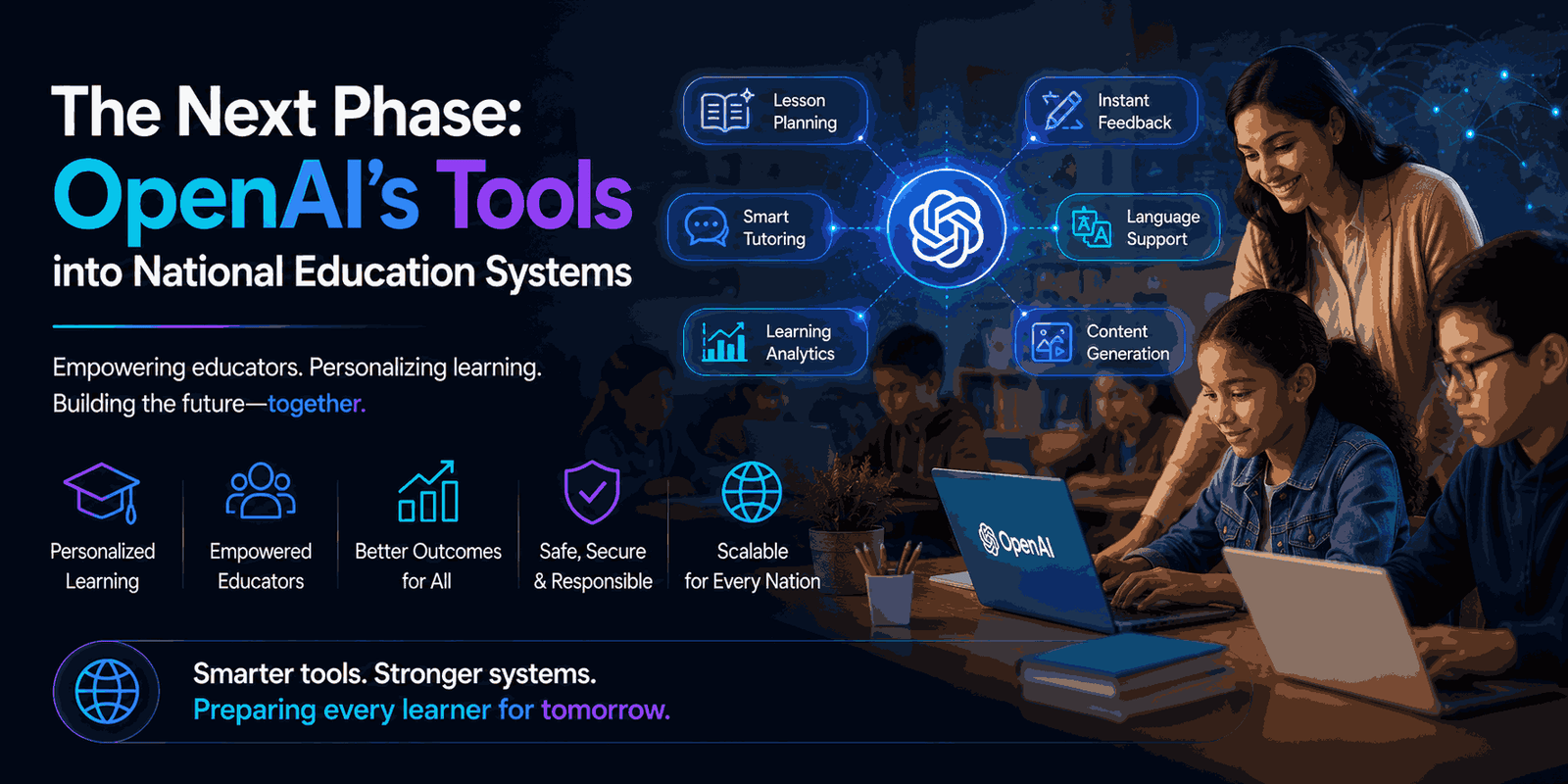
OpenAI, a leader in AI development, understands this big shift. Their “Education for Countries” initiative, first announced at Davos, is a pioneering effort to strategically bring OpenAI AI tools into national education systems worldwide. This isn’t just about giving access to ChatGPT. It’s about building large-scale, government-led research partnerships. These partnerships aim to tailor AI specifically for schools, ensure it’s adopted responsibly, and build a strong foundation of evidence for safe and impactful use.
The Vision: Helping Nations Thrive Through AI in Education
The main goal behind “Education for Countries” is clear: to improve learning for students and open up new economic opportunities for entire nations. OpenAI’s first group of partner countries, including Estonia, Greece, Italy, Slovakia, Trinidad & Tobago, Kazakhstan, the UAE, and Jordan, are actively working on this mission. Their collaborative approach rests on three key pillars:
-
Research First: Learning as We Go
Every implementation starts as a research partnership. Governments, educators, and OpenAI use a special Learning Outcomes Measurement Suite to jointly analyze AI’s impact on learners. This ongoing process helps refine the technology and builds a shared understanding of what truly works in different educational settings. -
Custom AI Tools for Local Learning
Partner countries get system-wide access to secure, private, and compliant versions of ChatGPT, Codex, and OpenAI’s API platform. The crucial part? These powerful AI-powered learning tools are customized to meet specific teaching and learning needs, always respecting local contexts and rules. -
Empowering Teachers: Training and Support
Recognizing that teachers are central to successful AI integration, the program heavily focuses on teacher AI training. This includes comprehensive AI literacy programs, professional development workshops, and certifications. All of these are designed to empower teachers to use these new tools confidently and responsibly in their classrooms.
Real Progress: Impact Across the Globe
The first phase of “Education for Countries” is already showing significant results and valuable insights from its diverse participants.
-
Estonia’s Digital Leap: A nation famous for its digital advancements, Estonia is leading the charge with a research-focused ChatGPT Edu rollout, managed by its AI Leap Foundation. This initiative is localizing the AI experience for schools, reaching over 20,000 students and 4,600 teachers. Collaborative research with the University of Tartu and Stanford is carefully measuring how AI affects learning in real classrooms. Plus, strong teacher enablement efforts, including professional learning communities and hackathons (like the Presidential Codex Hackathon, which sparked new ideas for classroom tools), are making sure educators are well-equipped.
-
Jordan: An AI Assistant for Everyone: In Jordan, over a million students and more than 100,000 teachers are now using “Siraj,” their national AI Education Assistant. This is part of a wider national push to use AI for better public services, showing the potential for widespread AI literacy for students and teachers.
-
Greece: Growing Local AI Talent: To encourage local talent and innovation, the OpenAI for Greece AI Startup Accelerator has supported 21 promising AI startups. This initiative aims to keep skilled individuals building within Greece, turning national ambition into new companies and ideas.
-
Kazakhstan: Country-Wide AI Adoption: A national ChatGPT Edu rollout across all 20 regions has seen over 84,000 educators complete specialized AI-readiness training. And get this: 9 out of 10 educators surveyed found ChatGPT Edu helpful, with 44,000 active users sending 1.5 million prompts in just the first month.
-
Slovakia: Saving Time for Educators: Early findings from universities in Slovakia show that over 90% of educators report increased productivity, saving about five hours weekly. The Ministry of Education even used Workspace Agents to draft new teacher professional standards in just hours – a job that usually takes months. This highlights the positive AI impact on learning outcomes not just for students, but for administrative efficiency too.
Singapore Joins the Educational AI Journey
Adding to this global effort, OpenAI recently brought Singapore into the “Education for Countries” initiative. Known for one of the world’s leading education systems, Singapore already has tech-savvy young people, with many young ChatGPT users leveraging it for learning.
OpenAI is working with Singapore’s Ministry of Education (MOE) and GovTech to develop custom solutions. These include tools for personalized learning, like interactive aids for learning mother tongue languages. Practical workshops and hands-on sessions through a Singapore-specific OpenAI Academy chapter, alongside Codex for Teachers hackathons, are ensuring that educational technology partnerships with AI are developed with a teacher-first approach, focusing on responsibility and fairness.
Why This Matters for Education’s Future
This systematic, research-backed way of bringing AI into classrooms is more than just rolling out new tech; it’s a huge investment in our future. By focusing on evidence-based deployments, measuring impact, and sharing findings globally, OpenAI and its partners are creating a clear roadmap for powerful, scalable government AI education programs.
This paves the way for a future where every student, no matter where they are, can access personalized learning, develop crucial digital skills, and be better prepared for a fast-changing world. The “teacher-first” philosophy, seen in upcoming initiatives like “OpenAI Luminaries,” reinforces the commitment to working with teachers themselves to shape how learning will look in the future.
Frequently Asked Questions (FAQ)
Q1: What is the main goal of OpenAI’s “Education for Countries” initiative?
A1: The primary goal is to improve student learning outcomes and create economic opportunities in partner countries. This is done by integrating OpenAI AI tools into national education systems through research, custom AI tools, and comprehensive teacher training.
Q2: Which countries are currently participating in the program?
A2: The first group includes Estonia, Greece, Italy, Slovakia, Trinidad & Tobago, Kazakhstan, the UAE, and Jordan. Singapore has also recently joined.
Q3: How does OpenAI ensure responsible AI deployment in schools?
A3: The program focuses on research-driven deployment. Each project starts as a partnership to understand AI’s impact, adapt the technology, and gather evidence on what works. It also includes extensive teacher AI training for confident and responsible usage.
Q4: Are the AI tools customized for each country?
A4: Yes, a core part of the initiative is providing secure, compliant, and private versions of ChatGPT, Codex, and OpenAI’s API platform that are specifically tailored to each country’s teaching and learning needs.
Q5: What kind of impact has been seen so far?
A5: Early impacts include improved teacher productivity, widespread AI readiness training for educators, millions of students engaging with AI education assistants, and the growth of local AI startup ecosystems.
Final Thoughts
Bringing AI into national education systems is a big, exciting challenge. OpenAI’s “Education for Countries” initiative is showing us a thoughtful, collaborative, and evidence-based way forward. By empowering educators, personalizing learning, and rigorously measuring impact, these partnerships aren’t just introducing new tools. They’re actively shaping the future of education with AI. This measured approach ensures that as AI continues to evolve, its application in learning will be both powerful and fair, preparing the next generation for challenges and opportunities we’re just starting to dream about.
Interested in exploring more about how AI is transforming learning? Stay tuned for our upcoming articles on specific AI literacy programs and advanced AI-powered learning platforms.