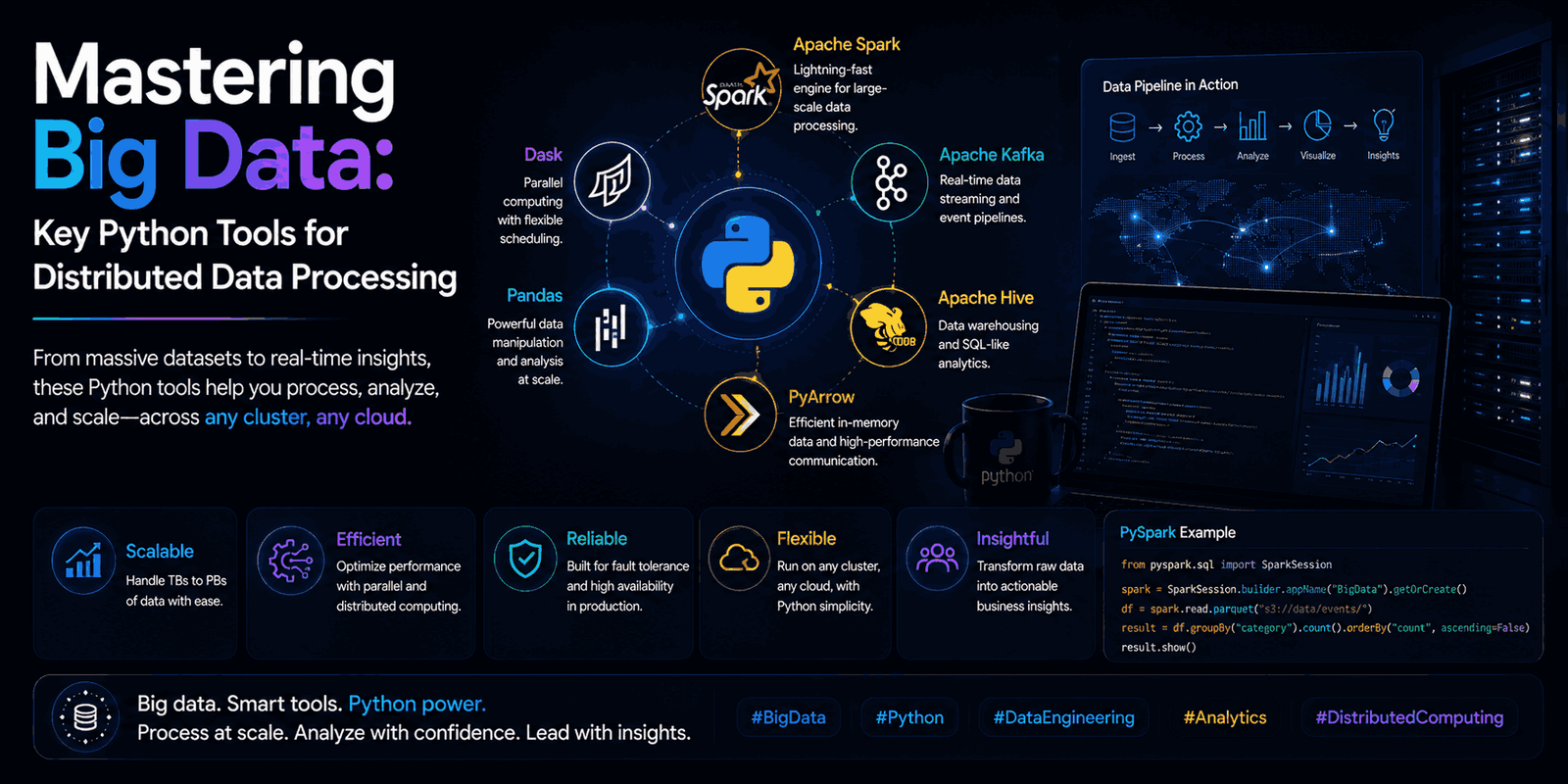
If you work with data in Python, chances are you lovepandas. It’s fantastic for manipulating and analyzing data on your laptop. But what happens when your dataset grows from a few gigabytes to terabytes – or even petabytes? Suddenly, your single machine’s memory isn’t enough.
Trying to process billions of rows, build complex distributed machine learning models, or handle live streams of events? Your usual tools just won’t cut it anymore.
This is where specialized Python tools for distributed data processing step in. These libraries and frameworks are built to handle data at scale. They let you perform computations across multiple machines (a cluster), work with data too big for your computer’s RAM, and fit right into modern cloud setups.
Ready to see how Python helps you conquer big data? Let’s dive into the essential tools.
PySpark: The Go-To for Big Data ETL
When people talk about “big data,” Apache Spark is often the first thing that comes to mind. PySpark is Spark’s official Python brain. It’s the industry standard for processing huge datasets in a distributed way.
PySpark is brilliant at running both batch jobs (like daily reports) and streaming computations (like live analytics) across large clusters. It uses a familiar DataFrame style, much like pandas, making it easier to pick up. Plus, it integrates perfectly with storage systems like HDFS, S3, Delta Lake, and most cloud data platforms. This makes it a core tool for data engineers in big companies.
- One API for Everything: Use the same tools for both batch processing and real-time data streams.
- Petabyte Scale: It can spread work across hundreds of computers, making sense of truly massive datasets—think petabytes!
- Built-in Machine Learning: Comes with MLlib, a comprehensive library for distributed machine learning, all within the Spark family.
Simply put, PySpark is often the foundation for reliable data pipelines and complex analytics in large organizations.
Dask: Scaling Pandas and NumPy Beyond Memory Limits
Dask solves a common problem: how do you use your existing pandas, NumPy, and scikit-learn code when your data won’t fit into memory?
Dask works by breaking your large dataset into smaller, manageable pieces. Then, it plans out all the computations in a “task graph.” This allows it to run efficiently, whether on your single laptop or across a big distributed cluster.
- Familiar Feel: Its APIs look so much like pandas and NumPy that you often need only tiny changes to your existing code to make it scale.
- Smart Operations: It doesn’t do anything until you ask for the final result. This “lazy evaluation” lets Dask optimize your computations, saving memory and speeding things up.
- Flexible Setup: You can easily switch from running Dask on your local machine to a full distributed cluster using Dask Distributed.
- ML Ready: Connects with popular machine learning libraries like XGBoost, PyTorch, and scikit-learn for training models in parallel.
Dask helps data scientists naturally move from analyzing data on their single machine to tackling distributed computing, without a steep learning curve.
Polars: Blazing Fast DataFrames with Rust Power
Meet Polars, a rising star in the DataFrame world. Written in Rust and built on the super-efficient Apache Arrow columnar memory format, Polars is making waves. It consistently beats pandas in speed tests, especially for analytical tasks. What’s more, Polars also supports lazy query optimization, making it suitable for datasets that would overwhelm traditional in-memory solutions.
- Parallel by Default: Right out of the box, it uses all your computer’s cores to run operations in parallel, making things incredibly fast.
- Clever Query Optimization: Its lazy API plans out your queries intelligently before running them. This means less unnecessary work and less memory used.
- Apache Arrow Heart: Being built on Arrow means it can share data with other Arrow-native tools like PyArrow and DuckDB without copying anything, which is super fast.
- Clean Code: Offers a clear and powerful way to write complex data transformations, helping you avoid long chains of confusing methods.
If you need serious speed for local analytics or any task where raw performance is key, Polars is a fantastic choice.
Ray: The Distributed Framework for Any Python Workload
Originally from UC Berkeley, Ray is a powerful and flexible distributed computing framework. It’s designed to scale almost any Python code across a cluster, and it’s particularly popular for machine learning. It includes tools like Ray Data for scalable data loading and Ray Train for organizing distributed model training.
- Easy Parallelization: Turn any Python function into a parallel one with just one simple
@ray.remotedecorator. It uses a straightforward task and actor model. - ML-Ready Data: Ray Data provides robust ways to stream, batch, and distribute data efficiently, which is crucial for large-scale machine learning pipelines.
- Deep Connections: It works seamlessly with top ML frameworks like PyTorch, TensorFlow, HuggingFace, and XGBoost.
Ray empowers researchers and engineers to build and scale complex AI systems without getting bogged down in the nitty-gritty details of distributed infrastructure.
Vaex: Analyzing Massive DataFrames on One Machine (Out-of-Core)
Not every huge dataset needs a whole cluster of machines. Sometimes, you can handle massive amounts of data—billions of rows—right on your single machine. That’s where Vaex comes in. It’s a Python library for “out-of-core” DataFrames, meaning it processes data without loading everything into your computer’s memory at once.
- Smart Memory Use: It efficiently “memory-maps” data directly from your disk. This allows standard computers to handle datasets that would otherwise be impossible.
- Lazy Calculations: Vaex only calculates results when you explicitly ask for them, keeping memory consumption to a minimum.
- Fast Operations: Offers incredibly fast
groupbyoperations, aggregations, and statistical calculations, all specifically optimized for huge datasets. - Works with Others: Plays well with Apache Arrow and HDF5 for efficient storage and easy data exchange.
Vaex is an excellent option for data scientists who need to analyze massive datasets locally, saving the need for cluster computing until it’s absolutely essential.
Apache Kafka with Python Clients: Real-Time Event Streams
When your applications demand high-speed, real-time data processing, Apache Kafka is the undisputed leader. It’s a distributed platform for streaming events. Python clients like kafka-python and confluent-kafka provide all the tools you need to send and receive continuous streams of data at scale.
- Incredible Speed: Can handle millions of events every second with very low delays.
- Never Lose Data: Its robust, distributed log design ensures your data is saved and available, even if something goes wrong.
- Flexible Architecture: Keeps data producers separate from consumers. This means different parts of your pipeline can grow and change independently.
- Ecosystem Friendly: Integrates smoothly with streaming engines like Spark Structured Streaming and Flink for real-time analytics.
Kafka is the backbone for things like live dashboards, fraud detection, ingesting data from IoT devices, and other applications that rely on immediate event processing.
DuckDB: SQL Analytics Right in Your Python Code
DuckDB offers something truly unique: an analytical database that runs inside your Python program. No external server needed! It’s fantastic for running super-fast Online Analytical Processing (OLAP) queries directly on your local files (like CSVs, Parquet, JSON). It perfectly blends the power of SQL with the flexibility of Python. Plus, its tight integration with pandas, Polars, and Apache Arrow makes it incredibly useful for data professionals who want SQL power without the setup hassle.
- Power for Local Files: Run complex SQL queries directly on various local file formats without having to load all the data into memory first.
- Blazing Fast: Its vectorized execution engine can compete with dedicated data warehouses for single-node analytical tasks.
- Zero-Copy Integration: Works seamlessly with pandas and Arrow. This means no slow data copying when moving data between your DataFrames and SQL queries.
DuckDB is ideal for quickly testing ideas, ad-hoc analysis of large local files, and adding strong SQL capabilities directly into your Python applications.
Why These Python Tools Matter for Modern Data Workflows
The world of data is always changing, with data volumes growing incredibly fast. Being able to effectively use these Python tools for distributed data processing isn’t just about handling bigger files; it’s about opening up entirely new possibilities. These frameworks empower data professionals to:
- Scale Smartly: Process data that’s far too big for a single machine or traditional memory-based tools.
- Boost Performance: Take advantage of parallel computing and optimized engines for much faster insights.
- Build Strong Pipelines: Create reliable batch, streaming, and machine learning pipelines that are ready for production.
- Make Big Data Accessible: Bring advanced data processing to a wider range of Python developers.
By understanding and using these tools, you can turn overwhelming big data challenges into manageable, scalable solutions.
FAQ: Scaling Python for Big Data
When should I consider moving beyond pandas for data processing?
You should think about moving past pandas when your datasets no longer fit comfortably in your computer’s RAM or when operations become too slow for your needs. This usually happens with data in the tens of gigabytes to terabytes range.
Which python tools for distributed data processing are best for batch ETL on clusters?
PySpark is generally the industry leader for distributed batch ETL pipelines on clusters. It offers powerful capabilities for data transformation and connects with many different data sources.
Can I scale my existing pandas code without a complete rewrite?
Yes! Dask is designed to scale your existing pandas and NumPy code with minimal changes. This lets you run it on datasets larger than memory or across distributed clusters. Polars also offers a similar DataFrame API with significant speed improvements.
What’s the best tool for real-time data ingestion in Python?
Apache Kafka, along with its Python clients like confluent-kafka, is the standard for building high-throughput, low-latency real-time data streaming and ingestion pipelines.
Is it possible to analyze huge datasets on a single machine efficiently?
Absolutely. Libraries like Vaex are excellent for “out-of-core” DataFrame analysis on a single machine. They let you work with billions of rows by mapping data from your disk instead of loading it all into RAM.
Final Thoughts
The sheer amount of data available today demands smart solutions, and Python’s ecosystem continues to deliver. The tools we’ve looked at—from the distributed power of PySpark and Ray to the local speed of Polars and DuckDB, and the real-time capabilities of Kafka—give you a complete toolkit for any data professional.
Whether you’re building robust data pipelines, speeding up machine learning, or performing lightning-fast analytics on massive files, these Python tools for distributed data processing offer the scalability and performance you need. We highly recommend you try out these libraries and see how they can transform your next big data project. The journey to mastering large-scale data processing in Python is an exciting one, full of powerful new possibilities waiting for you!