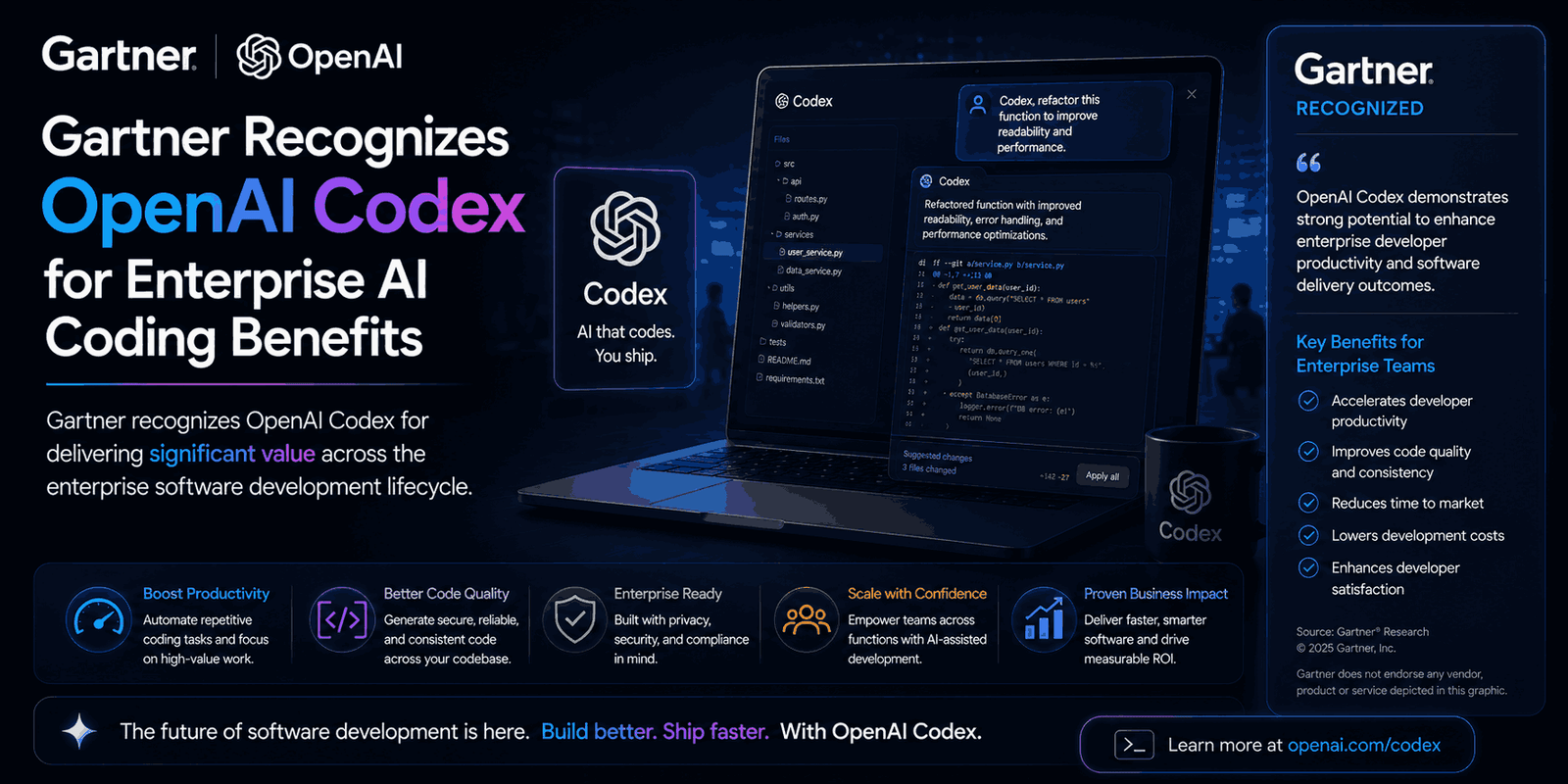
Big news in the world of AI and software development! Gartner, a well-respected name in tech analysis, recently recognized OpenAI as a Leader in their 2026 Magic Quadrant™ for Enterprise AI Coding Agents.
What does this mean? It’s a clear signal that AI in coding isn’t just a futuristic concept anymore. It’s a mature, powerful tool that’s truly transforming how businesses create software. OpenAI’s Codex is right at the forefront of this shift.
This isn’t just about AI helping you finish your code faster. It’s about a fundamental change in how companies build, maintain, and secure their software. This recognition by Gartner highlights the deep OpenAI Codex enterprise AI coding benefits that are starting to reshape the entire industry.
The Rise of Agentic Software Development
Remember when AI tools just gave you code suggestions? That’s old news. We’re now seeing the rise of “agentic” software development. Think of it as AI coding agents like Codex doing more than just snippets.
These agents can understand complex tasks, navigate through huge amounts of existing code, use different developer tools, run tests, and even get work ready for a human developer to review. This capability to handle intricate coding tasks frees up development teams, helping them work incredibly fast while still keeping crucial control over the process.
For big organizations, this means a whole new way to speed up development cycles. Codex lets you build faster, but it also includes built-in governance, security, and auditability – things no enterprise can compromise on.
Why Codex Stands Out: Gartner’s Perspective
Gartner’s review praised Codex for both its “Ability to Execute” (how well it performs now) and its “Completeness of Vision” (its future potential). Here’s what they specifically highlighted:
- Agentic Capabilities: It can handle sophisticated, delegated code generation and task execution – basically, doing complex coding work on its own.
- Enterprise Governance: Robust controls are in place, like approval steps, role-based access (RBAC), and custom policies, ensuring everything meets company standards.
- Sandboxing: Code is run in secure, isolated environments (OS-level sandboxing) to prevent any unwanted interference or security risks.
- Flexible Deployment: You have options for how to integrate Codex into your existing infrastructure.
- Broad Developer Surface: It works with the Codex app, IDE extensions, command-line interfaces (CLI), SDKs, and cloud orchestration, fitting into various developer workflows.
These features together make a strong case for Codex, addressing both how productive developers can be and the strict operational needs of large companies.
Real-World Impact: Cisco’s Experience with Codex
The power of agentic AI coding isn’t just theoretical. Companies are already seeing real results.
Take Cisco, for example. They used Codex to develop a big chunk of their AI Defense security platform. This collaboration drastically cut down the project’s delivery time – from many quarters down to just weeks. This kind of efficiency gain shows how integrated AI can become a huge strategic advantage, helping companies innovate and deploy products faster without sacrificing quality or security.
Continuous Evolution: Codex Enhancements for Enterprise Use
OpenAI isn’t resting on its laurels. They’ve been constantly improving Codex, especially for their enterprise clients. Recent updates include:
- GPT-5.5 Integration: Significant improvements to the core AI model mean better tool use and faster performance.
- Enhanced Security: Features like Codex Security and GPT-5.5-Cyber provide trusted access, especially useful in cybersecurity contexts.
- Expanded Accessibility: Now with mobile support and Remote SSH for managed development environments, making it even easier to use.
- Granular Control: Scoped programmatic access tokens and hooks offer more precise control over access management.
- Compliance: It now supports HIPAA-compliant use cases, which is crucial for regulated industries like healthcare.
- Cloud Integration: Codex is available on Amazon Bedrock, expanding its reach.
- Partnerships: OpenAI has expanded deployment support through Codex Labs and global system integrators like Accenture, Capgemini, and PwC, making it easier for companies to adopt.
These ongoing improvements show OpenAI’s dedication to creating a secure, robust, and adaptable AI coding agent that can meet diverse enterprise needs. The combined OpenAI Codex enterprise AI coding benefits are quickly making it an essential tool for forward-thinking organizations.
Why This Matters for Your Business
Gartner’s recognition of OpenAI Codex is more than just an award; it’s a message to businesses everywhere. As Denise Dresser, CRO of OpenAI, perfectly puts it, companies are no longer asking if AI can write good code. Instead, they’re asking “how to safely deploy agentic systems at scale as a new operating layer for their businesses.”
Codex is moving beyond just being a coding assistant. It’s becoming a comprehensive solution that fits into broader enterprise workflows.
If your business deals with complex software development, integrating advanced AI coding agents like Codex offers a clear path to boosting productivity, strengthening security, and getting products to market much faster. It’s about giving human developers intelligent tools that handle the heavy lifting, allowing them to focus on innovation and solving strategic problems.
Frequently Asked Questions
Q1: What does “agentic software development” mean for my business?
A1: “Agentic software development” means AI systems can handle complex, multi-step coding tasks on their own. This includes everything from understanding project requirements to writing code, testing it, and preparing it for review. For your business, this translates to quicker development cycles, more productive developers, and potentially lower operational costs.
Q2: How does OpenAI Codex ensure enterprise-level security and governance?
A2: OpenAI Codex comes with strong enterprise-grade features. These include approval gates, role-based access control (RBAC), customizable policies, OS-level sandboxing, and auditable workspace governance. All of these work together to ensure AI-generated code meets your organization’s security and compliance standards.
Q3: Can Codex integrate with existing enterprise development tools and workflows?
A3: Absolutely. Codex is designed to be highly adaptable. It works with its own app, IDE extensions, command-line tools (CLI), SDKs, and cloud-based orchestration. This makes it easy to integrate into your current enterprise software development workflows and toolchains.
Q4: What are the key OpenAI Codex enterprise AI coding benefits for large organizations?
A4: For large organizations, the main benefits include significantly faster development timelines, a big boost in developer productivity, improved code quality thanks to advanced AI, stronger security and governance controls, and flexible deployment options that fit smoothly into complex enterprise environments.
Final Thoughts
The days of AI being just a simple assistant are quickly fading. We’re now entering an era of powerful agentic systems. OpenAI’s recognition by Gartner for its Codex solution confirms its leadership in this crucial area.
For enterprises looking to unlock significant gains in efficiency, security, and innovation within their software development, understanding the OpenAI Codex enterprise AI coding benefits isn’t just an option—it’s becoming a strategic necessity. If your organization is ready to tap into this transformative power, now might be the perfect moment to explore what Codex can do for you.