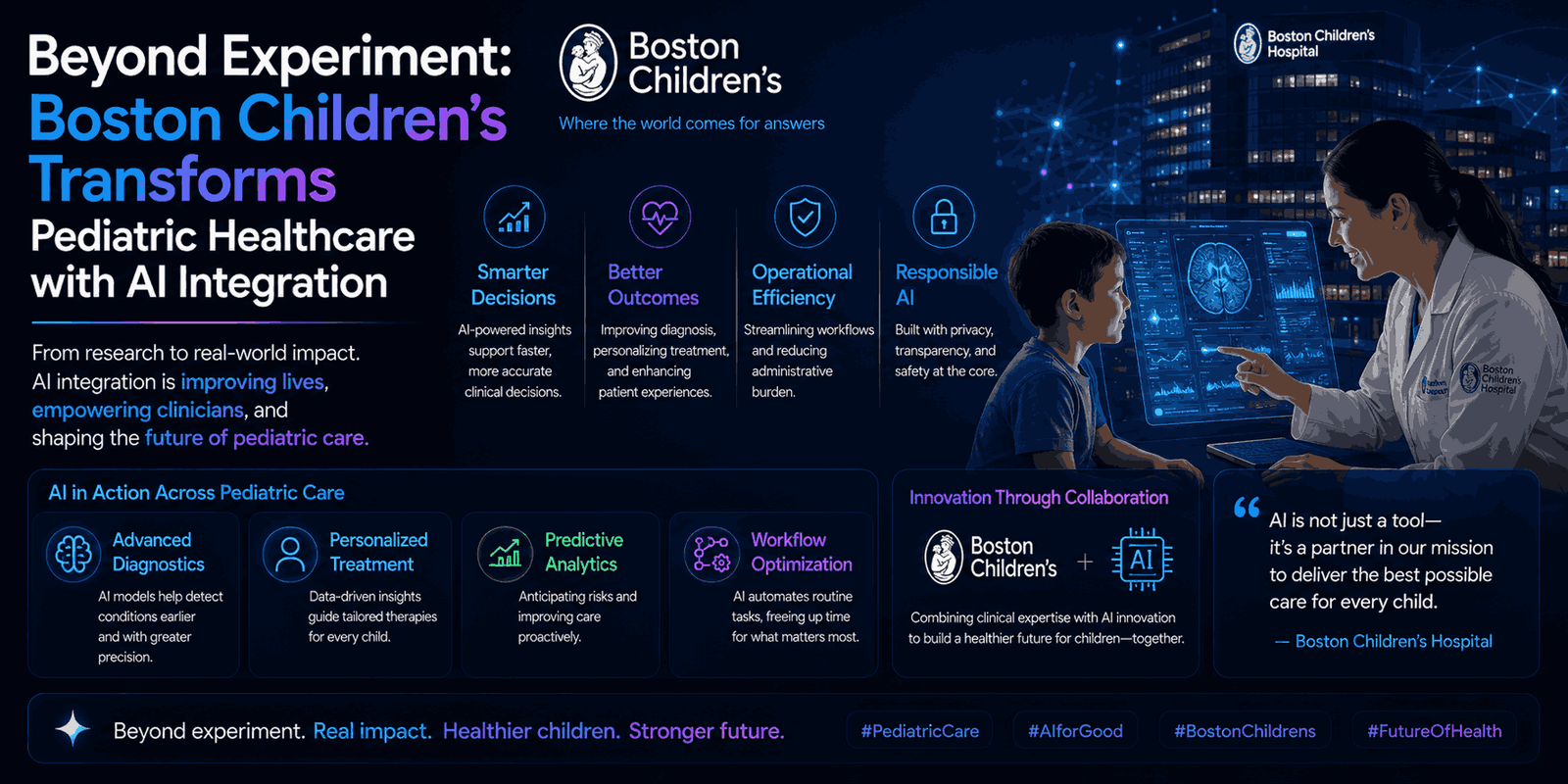
Boston Children’s Hospital isn’t just trying out new tech. This global leader in pediatric care has strategically woven artificial intelligence (AI) deep into how they deliver care to young patients. It’s a fundamental shift, not just a passing trend.
This isn’t about chasing novelty. It’s a smart, systematic way to tackle some of healthcare’s toughest problems, especially for children with complex and rare conditions. Through this significant AI integration in pediatric healthcare, Boston Children’s has actually cut operational costs, made it easier for patients to get care, and incredibly, solved more than 40 rare disease diagnoses that had stumped doctors for ages.
The Big Challenges Facing Modern Pediatric Hospitals
Running one of the world’s largest children’s hospitals means huge responsibility and constant hurdles. Boston Children’s sees almost a million outpatients a year across over 40 specialties. Like many health systems, they’re always navigating tight budgets while dealing with more and more administrative tasks.
Every day, teams in areas like supply chain, billing, and operations face a ton of repetitive work. Think processing invoices or coordinating tricky schedules. These vital tasks eat up a lot of staff time, pulling valuable people away from patient care – which is where they’re needed most.
Clinically, the challenges are just as big, especially with rare diseases. These cases often involve fragmented genetic data, incomplete patient histories, and a mountain of medical research. Even at a top research hospital, doctors simply can’t process all this information fast enough to catch every possible diagnosis. As John Brownstein, Boston Children’s Chief Innovation Officer, puts it, “The problem isn’t effort. It’s human cognitive limits.”
Building a Foundation: An Enterprise AI Layer
Boston Children’s first dipped its toes into AI with individual tools, like basic documentation or translation apps. But soon, they realized a scattered approach had limits. They needed something more unified.
So, they made a big change. Instead of deploying separate tools, they started building what Brownstein calls an “enterprise AI layer.” Imagine a secure, internal ChatGPT environment designed for everyone – research, clinical, and administrative teams – to use seamlessly. This move turned AI from a bunch of isolated solutions into one shared, powerful foundation. Now, new capabilities could be developed and scaled quickly.
This centralized system lets teams use AI in ways that directly help their specific jobs. Maybe it’s accessing internal data, sifting through complex medical literature, or making workflows smoother. Crucially, they also set up strong rules and oversight to ensure everything was safe, monitored, and constantly evaluated. This hospital-wide approach dramatically sped up innovation. Tools that used to take months or years to build can now be deployed in just days, quickly responding to both operational and clinical needs. Today, over a third of Boston Children’s employees regularly use AI in their daily work.
Changing How Work Gets Done and Boosting Efficiency
The hospital initially focused on putting AI where it could show clear operational results. For instance, in the supply chain, AI now intelligently handles invoice intake, routing, and responses. This has significantly streamlined what used to be a clunky process.
At the same time, AI was applied to surgical scheduling. By carefully analyzing clinical notes and estimating how sick patients are, the system optimizes operating room time. This means schedules can be planned further in advance, making better use of facilities and ensuring more patients get timely, essential care.
Beyond these examples, doctors now use AI for clinical decision support, helping them process vast amounts of complex information. Researchers use it to analyze data and build patient groups, while administrative teams rely on it for drafting documents, coding, and general workflow improvements.
These changes aren’t just theoretical. Boston Children’s directly links them to real results. Across more than 50 automated processes, the hospital has saved roughly 60,000 hours of staff time. That’s over $7 million in labor that can be redirected to other important areas. The key, as Brownstein highlights, is making AI relevant to everyday work, meeting people where they are, rather than forcing it as a separate project.
Unlocking Rare Disease Diagnoses and Genetic Discoveries
Perhaps the most impactful use of AI at Boston Children’s is in clinical discovery, especially for rare diseases. The hospital developed a sophisticated “co-pilot geneticist” system. This system brings together genetic data, patient symptoms (phenotypic information), and all the medical literature in the world.
This system directly tackles one of medicine’s toughest challenges: diagnosing rare conditions that have baffled experts for years. The results are truly remarkable. So far, this AI-powered approach has led to over 40 diagnoses that doctors once thought were impossible. What’s more, this work has also helped identify new gene targets and potential treatment paths.
“We combine genetic information, phenotypic information, literature search, and the reasoning of AI to deliver diagnoses to families that were once left without any answers,” Brownstein explains. For families who have faced years of uncertainty, the impact is immediate and profound. Cases that were once open-ended now get answers, and often, clear directions for treatment. “This was unthinkable before,” Brownstein states, “but is now providing hope to so many families.”
The Future of AI-Powered Care at Scale
Boston Children’s journey is far from over. The next step in their AI strategy is even deeper integration and wider adoption. Leadership sees huge potential to expand both the use and impact of AI across the entire institution. The hospital is committed to embedding AI more fully into clinical decision-making, bringing its powerful tools to diverse medical specialties, and constantly improving its models through ongoing collaboration with partners like OpenAI.
Ultimately, AI is quickly becoming an essential part of medical practice. As Brownstein reflects, “How would you not want an incredibly trained physician alongside all the world’s medical knowledge?” At Boston Children’s, AI is rapidly moving from an experimental tool to a core piece of their infrastructure, supporting every part of care, research, and discovery – truly redefining what’s possible for both medical teams and the patients they serve.
FAQ Section
Q: Why did Boston Children’s Hospital prioritize AI integration?
A: Boston Children’s embraced AI not for experimentation, but to fundamentally improve patient care for complex pediatric conditions, reduce operational costs, and enhance access, addressing human cognitive limits in data synthesis.
Q: What is an “enterprise AI layer” in a hospital setting?
A: An enterprise AI layer is a secure, unified internal AI environment (like an internal ChatGPT system) that provides a shared foundation for developing and deploying AI capabilities across all departments—clinical, research, and administrative—rather than relying on fragmented, one-off solutions.
Q: How has AI improved operations at Boston Children’s?
A: AI has streamlined tasks like invoice processing in supply chain, optimized surgical scheduling for better operating room utilization, and provided decision support for physicians, leading to significant time savings and cost reductions.
Q: What impact has AI had on rare disease diagnosis?
A: By integrating genetic data, patient information, and medical literature, Boston Children’s AI “co-pilot geneticist” has enabled over 40 rare disease diagnoses that were previously impossible, offering crucial answers and potential treatment pathways to families.
Q: Is AI replacing doctors at Boston Children’s?
A: No, AI acts as a powerful co-pilot and decision support tool, augmenting the capabilities of physicians and medical teams by handling vast data synthesis and complex analysis, freeing up human staff for higher-value, patient-facing work.
Final Thoughts
The incredible progress at Boston Children’s Hospital gives us a compelling look into the future of healthcare. Their systematic and deep AI integration in pediatric healthcare shows that AI is no longer a futuristic concept, but a powerful, practical tool improving lives right now. It’s proof that thoughtful use of technology, combined with strong ethical guidelines, can boost human potential and bring hope where it once seemed out of reach. As more institutions follow this path, we can expect a new era of medical breakthroughs and more accessible, precise care for everyone.