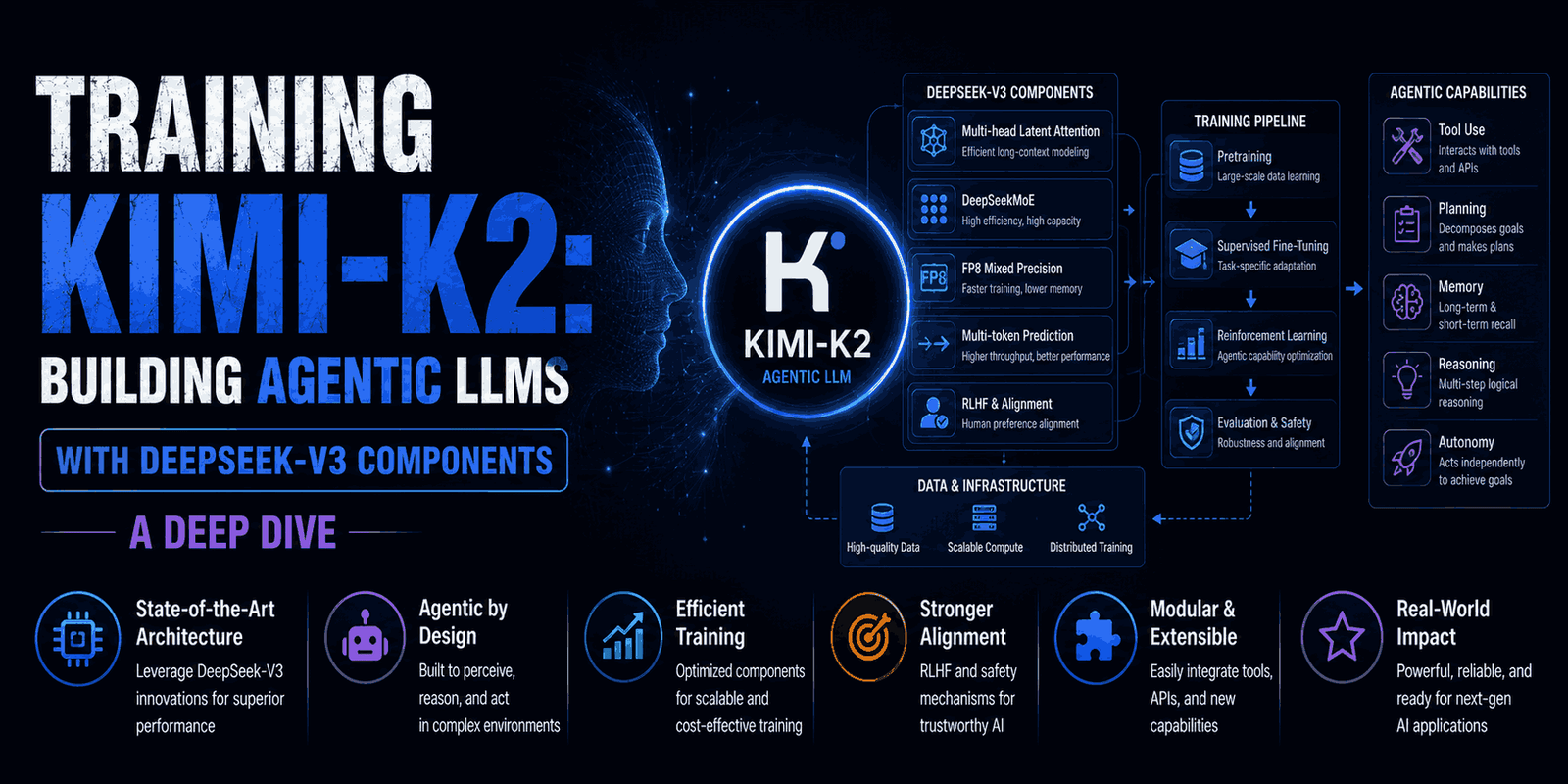
The world of AI is buzzing with the term agentic intelligence. It’s not just about creating cool text anymore; it’s about building models that can truly think, plan, reason, and act more like an agent within the digital world. This is a huge leap from simply mimicking human language to actively learning through interaction, picking up new skills, and adapting its behavior based on experience. Such capabilities are vital for the next generation of AI, from using complex tools to helping develop software.
Leading this charge is Kimi-K2. This impressive model boasts 1.04 trillion parameters and is a sophisticated Mixture-of-Experts (MoE) design. Kimi-K2 was specifically developed to tackle the intricate challenges of creating agentic AI, and its strong performance on benchmarks places it high among open-source models.
In this article, we’ll peel back the layers of Kimi-K2. We’ll look at its architectural differences from DeepSeek-V3, explore the unique MuonClip optimizer, and see how Kimi-K2 optimizes its training data. Plus, we’ll touch on how it all comes together, using DeepSeek-V3’s framework as a starting point.
Kimi-K2 vs. DeepSeek-V3: Architectural Choices for Agentic LLMs
Kimi-K2 isn’t built from scratch; it takes the robust foundation of DeepSeek-V3 and adds some crucial modifications. These changes are all about boosting its agentic capabilities and making inference more efficient. Understanding these tweaks is key to appreciating Kimi-K2’s thoughtful design.
Mixture-of-Experts Scaling: Smarter Sparsity in Kimi-K2
One of the most significant changes in Kimi-K2 is how it handles sparsity, especially within its Mixture-of-Experts (MoE) layers. The Kimi team made an interesting discovery: if you keep the activated parameters constant (meaning the same computational load or FLOPs), you can actually lower training and validation loss by increasing the total number of experts. This led them to make Kimi-K2 significantly sparser.
Let’s break down the numbers:
- DeepSeek-V3: Uses 256 experts, with 8 active experts per token. This gives it about 671 billion total parameters, with roughly 37 billion activated at any given moment.
- Kimi-K2: Takes a big step up to 384 experts – a 50% increase! It still uses 8 active experts per token. This makes Kimi-K2 much sparser, with a ratio of 48 (384/8) compared to DeepSeek-V3’s 32 (256/8).
Despite having a larger total parameter count of 1.04 trillion (that’s 54% more than DeepSeek-V3), Kimi-K2 actually reduces its activated parameters to 32.6 billion (13% less). This smart design strikes a balance between model quality and efficient inference, allowing Kimi-K2 to perform exceptionally well without demanding excessive computing power.
Attention Head Optimization for Efficient Long-Context LLMs
For agentic applications, handling very long pieces of text (known as “long contexts”) efficiently is incredibly important. DeepSeek-V3 typically uses many attention heads (e.g., 128 heads for 61 layers) to make the most of memory bandwidth. However, as context lengths grow, this design can become quite expensive during inference.
The Kimi team found that for a 128k sequence length, simply doubling the attention heads from 64 to 128 (while keeping 384 experts) drastically increased inference computational requirements (FLOPs) by 83%. Yet, the performance gains in terms of validation loss were only marginal (0.5% to 1.2%).
Considering Kimi-K2’s high sparsity already delivers strong performance, these minor gains didn’t justify the extra inference cost. So, Kimi-K2 opts for 64 attention heads—half of DeepSeek-V3’s. This significantly cuts down on inference costs for long-context agentic tasks while still maintaining competitive performance.
The MuonClip Optimizer: Stabilizing Large-Scale LLM Training
Building Kimi-K2 also required a new way to approach training. The MuonClip optimizer is a core innovation that ensures training stability for trillion-parameter models, all while maintaining token efficiency. To understand MuonClip, we first need to look at its predecessor, the Muon optimizer, and its unique stabilization mechanism, QK-Clip.
Why Token Efficiency Matters in LLM Training
As high-quality human-generated data becomes scarcer, token efficiency is a crucial concern when scaling LLMs. This simply means how much performance improvement a model gets for each token it processes during training.
The original Muon optimizer, which came before MuonClip, proved to be more token-efficient than traditional optimizers like AdamW under similar computing budgets and model sizes. This made Muon a promising candidate for extracting maximum “intelligence” from limited, high-quality training data.
However, when trying to scale the basic Muon optimizer to models with trillions of parameters, a big problem surfaced: training instability caused by exploding attention logits.
The Attention Logit Explosion Problem
During tests with the basic Muon optimizer on medium-sized models, a phenomenon called “attention logit explosion” would occur. Attention logits (the raw scores before the softmax function in an attention layer) would rapidly shoot past values of 1000. This led to numerical instabilities and sometimes caused the training process to completely fail. This issue was more common with Muon than with AdamW, suggesting that Muon’s aggressive optimization dynamics amplified these instabilities.
Existing methods to fix this problem weren’t enough:
- Logit soft-capping (used in models like Gemma) clips attention logits directly. But the intermediate dot products between queries and keys can still become excessively large before the capping even happens.
- Query-Key Normalization (QK-Norm) isn’t compatible with Multi-head Latent Attention (MLA), a common architecture. This is because the full key matrices aren’t explicitly created during inference, making normalization difficult.
QK-Clip: A Smart Solution for Stable LLM Training
To tackle the attention logit explosion, the Kimi team introduced QK-Clip. This is a clever weight-clipping technique that indirectly controls attention logits by rescaling the query and key projection weights after they’ve been updated.
The beauty of QK-Clip is its simplicity. It doesn’t interfere with the current training step’s forward or backward passes. Instead, it uses the maximum attention logits (which are tracked during the forward pass) as a signal to guide how much the weights should grow. When the maximum logit for an attention head goes above a certain threshold (set to 100 for Kimi-K2), QK-Clip rescales the query and key weights for only that specific head.
This “per-head” clipping is important because it only acts where needed. It minimizes disruption to other attention heads that are already stable. By rescaling the weights that generate the logits, QK-Clip effectively keeps the logits in check without directly clipping them, which could potentially hurt learning.
Optimizing Training Data for Kimi-K2: Enhancing Token Utility
Beyond architectural choices and optimizer innovations, a huge part of Kimi-K2’s performance comes from how it handles training data. With high-quality human-generated data becoming more scarce, the focus shifts to maximizing token utility – essentially, how much useful learning signal each token contributes to the model’s updates.
Maximizing Learning per Token in LLM Training
Token efficiency in pre-training covers two related ideas:
- Optimizer efficiency: How well the optimizer (like MuonClip) extracts useful information from each gradient update.
- Token utility: The actual information density and learning potential within each token itself.
Improving token utility directly boosts overall token efficiency. A simple approach might be to show the model the same tokens multiple times (more epochs), but this often leads to overfitting and limits the model’s ability to generalize to new data. Kimi-K2 addresses this with a sophisticated synthetic data generation strategy designed to amplify the value of high-quality tokens without causing overfitting.
Knowledge Data Rephrasing for Better Training Quality
Training on knowledge-rich text presents a challenge: one pass isn’t enough for the model to absorb everything, but too many repetitions can lead to diminishing returns. Kimi-K2 solves this with a smart synthetic rephrasing framework, featuring three main components:
1. Style- and Perspective-Diverse Prompting
To add linguistic variety while keeping facts accurate, specific prompts guide another LLM to rephrase content in different styles and perspectives. This ensures the core factual information remains consistent, while the diverse phrasing helps Kimi-K2 learn robust representations of the same knowledge, no matter how it’s worded.
2. Chunk-wise Autoregressive Generation
Long documents can be tricky for LLM-based rewriting due due to length limitations. Kimi-K2 breaks documents into segments, rephrases each segment while preserving context, and then stitches them back together. This method avoids losing information and maintains the overall coherence of lengthy texts.
3. Fidelity Verification
To guarantee that the rephrased content is consistent with the original, fidelity checks are performed. These checks compare the semantic meaning of each rewritten passage with its source, preventing factual errors or “hallucinations” from creeping in during the rephrasing process.
Mathematics Data Rephrasing
To improve mathematical reasoning, high-quality math documents are rewritten into a “learning-note” style. This transforms dense academic material into a more pedagogical format, making it easier for the model to learn. Additionally, translating high-quality math content from other languages into English further expands the training data pool, boosting diversity.
The Kimi-K2 Pre-training Corpus
The complete Kimi-K2 pre-training corpus is absolutely massive, comprising 15.5 trillion tokens of carefully curated, high-quality data. This data spans four key domains:
- Web Text: For general knowledge and natural language understanding.
- Code: For programming skills and structured reasoning.
- Mathematics: For quantitative reasoning and formal problem-solving.
- Knowledge: For specialized domain expertise and factual information.
Implementing Kimi-K2 with DeepSeek-V3 Components
Bringing Kimi-K2 to life involves integrating these innovations into a practical training pipeline, often by leveraging existing frameworks like DeepSeek-V3. Here, we’ll outline the key implementation aspects that make Kimi-K2’s training unique.
Multi-Head Latent Attention (MLA) with Max Logit Tracking
Kimi-K2 enhances DeepSeek-V3’s Multi-head Latent Attention (MLA) mechanism to support QK-Clip. The core modification is adding per-head max-logit tracking during the forward pass. This means that as the attention scores are calculated, the maximum logit value for each individual attention head is recorded. This tracked information then serves as the crucial signal for the QK-Clip optimizer to decide if and how much to clip weights. This non-invasive tracking adds minimal computational overhead but provides the vital data needed for stable training.
Implementing the MuonClip Optimizer for Stable LLM Training
The MuonClip optimizer is central to Kimi-K2’s stability. Its implementation combines several advanced techniques:
- Newton-Schulz Orthogonalization: Helps maintain the desired properties of the weight matrices.
- RMS Matching: Ensures that Muon’s updates are comparable in magnitude to those of optimizers like AdamW, simplifying hyperparameter tuning.
- Weight Decay: A standard regularization technique to prevent overfitting.
- Per-head QK-Clip: As discussed, this is applied after the main weight updates. It takes the
max_logitstracked by the attention layers and, if a head’s logits exceed the threshold, it rescales that head’s query and key projection weights in-place. This direct, in-place modification avoids unnecessary memory allocation and efficiently keeps logits under control.
This integrated approach allows MuonClip to provide the efficiency benefits of Muon while preventing the training instabilities often seen with very large models.
Complete Kimi-K2 Training Pipeline: Setup and Optimization
A typical Kimi-K2 training setup might involve configurations like:
- Disabling Multi-Token Prediction for simplified training.
- Using a scaled-down number of experts (e.g., 8 instead of hundreds for educational examples) and attention heads (e.g., 4) for smaller-scale implementations.
- Leveraging gradient accumulation (e.g., 4 steps) to simulate larger batch sizes, which is helpful when GPU memory is limited.
- Employing mixed-precision training (fp16) to speed up training and reduce memory footprint.
- Configuring regular evaluation and checkpointing for monitoring progress and saving model states.
- Using a conservative learning rate with a brief warmup period for stable initial training.
Crucially, the custom MuonClip optimizer needs to be registered with the training framework (like Hugging Face Trainer), and the model’s attention layers must be linked to the optimizer so QK-Clip can access the max_logits information. This meticulous setup ensures that all the architectural and optimization innovations work together seamlessly to facilitate robust and efficient training of Kimi-K2.
Why Kimi-K2’s Approach Matters
Kimi-K2’s development shows a focused effort to push the boundaries of LLM capabilities, especially in agentic AI. By refining architectural elements, introducing advanced optimization techniques like MuonClip with QK-Clip, and carefully crafting its training data, Kimi-K2 aims to deliver superior performance and efficiency.
These innovations aren’t just about achieving high benchmark scores; they represent vital steps toward building truly intelligent systems that can understand, reason, and act in complex, real-world scenarios. As we move towards more autonomous AI agents, the ability to train massive models stably, efficiently, and effectively from vast datasets becomes paramount. Kimi-K2 offers a compelling blueprint for how to achieve this balance.
Frequently Asked Questions (FAQ)
What is agentic intelligence in LLMs?
Agentic intelligence refers to an LLM’s ability to autonomously understand its environment, plan actions, reason through problems, and execute those actions. It learns and adapts through interaction, rather than just generating text based on static training.
How does Mixture-of-Experts (MoE) help Kimi-K2?
MoE allows Kimi-K2 to have a very large total number of parameters (over a trillion) but only activate a smaller subset (32.6 billion) for each token. This makes the model incredibly capable while keeping inference costs manageable compared to a dense model of similar total size.
What problem does the QK-Clip optimizer solve?
QK-Clip tackles the problem of “attention logit explosion” during large-scale LLM training, especially with aggressive optimizers like Muon. It prevents numerical instabilities and training failures by intelligently rescaling query and key weights for specific attention heads that show signs of exploding logits. This ensures stable training without directly clipping the logits themselves.
Final Thoughts
Kimi-K2 stands as a testament to the continuous innovation happening in the field of large language models. By thoughtfully modifying the DeepSeek-V3 architecture, introducing the stabilizing MuonClip optimizer with its clever QK-Clip mechanism, and meticulously optimizing its training data through rephrasing strategies, the Kimi team has developed a highly capable and efficient agentic LLM.
This work highlights the intricate balance needed to scale AI models to unprecedented sizes while ensuring both stability and performance. As we continue to build more sophisticated AI, techniques pioneered in models like Kimi-K2 will undoubtedly pave the way for future advancements in intelligent systems.
Curious to learn more about advanced AI architectures, large language model training, or optimization techniques? Dive deeper into these topics and more in our comprehensive resources on AI development.