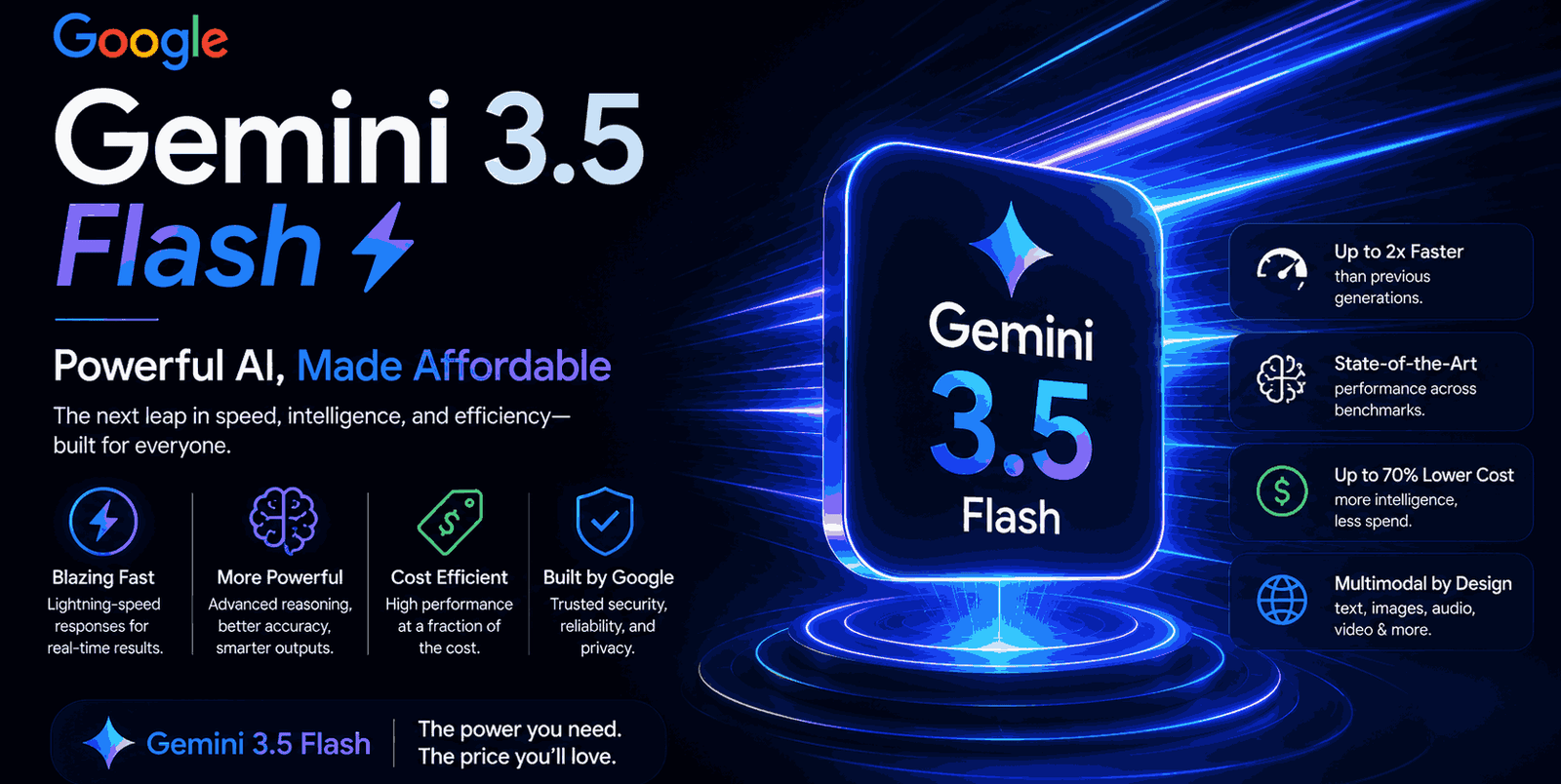
The world of AI moves at an astonishing pace. For businesses, keeping up can be exhilarating but also incredibly expensive. At Google I/O 2026, Google made it clear they’ve heard these concerns, especially when it comes to the rising costs of running advanced AI models and agents.
Their latest announcement, Gemini 3.5 Flash, aims to change that. Alongside big updates to their AI agent platform and new multimodal capabilities, Google is making a strong push to bring advanced AI within reach for companies of all sizes. Let’s dive into what these updates mean for the future of enterprise AI.
The AI Cost Problem, Solved (Mostly) with Gemini 3.5 Flash
One of the biggest hurdles for businesses adopting AI is the cost of “tokens.” Think of tokens as how AI models measure and process information – every word or piece of data costs money. As companies expand their AI agent use for complex tasks, these token costs can quickly pile up, sometimes even blowing annual budgets much faster than expected.
Google’s Gemini 3.5 Flash is designed specifically to tackle this problem head-on. Google is positioning it as one of the most cost-effective “frontier” models available. How cost-effective? It’s priced at just $1.50 per million input tokens. To give you some perspective, a competitor like Anthropic recently lowered costs for its Claude Opus 4.6 model, but Gemini 3.5 Flash still comes in significantly lower.
Google CEO Sundar Pichai highlighted this focus, suggesting that mixing more affordable models like Flash with other advanced options could lead to substantial savings for businesses. Industry analysts agree, noting that offering cheaper, faster, and better models is a natural and necessary step in today’s competitive AI market.
Why Lower Token Costs Are a Game-Changer for Businesses
There’s no doubt that businesses want AI, but high costs can slow down adoption and stop companies from really scaling their AI initiatives. When proprietary models are expensive, many companies start looking for open-source alternatives that offer similar performance without the hefty price tag.
By reducing token costs, Google aims to make its advanced generative AI models more competitive and remove a major barrier for enterprises. This means businesses can run more AI applications, process larger datasets, and experiment with their AI strategies without constantly worrying about budget overruns. It’s about enabling growth, not limiting it.
Beyond Cost: Google’s Other Big AI Announcements
While cost-efficiency is a huge theme, Google’s I/O announcements weren’t just about saving money. They also unveiled new models and significant updates to their AI agent ecosystem.
Gemini Omni Flash: The Multimodal Powerhouse
Along with Gemini 3.5 Flash, Google introduced Gemini Omni Flash. This is a specialized multimodal model. What does “multimodal” mean? It means the AI can understand and generate content using different types of data – not just text, but also images and video. Imagine an AI that can watch a video clip, analyze an image, and then respond with a written explanation or even create new visuals based on your request. This capability opens up a world of richer, more interactive AI applications across industries.
Gemini Spark: Your New Personal AI Agent
Another exciting addition is Gemini Spark, a new personal AI agent built for both everyday users and developers. Running on dedicated machines within Google Cloud, Spark integrates deeply with popular Google Workspace tools like Gmail, Docs, Sheets, and Slides, as well as third-party applications.
Think of it as a super-smart assistant that can:
- Gather information from your emails and documents.
- Manage RSVPs and automatically update spreadsheets.
- Send timely follow-up reminders.
Google explicitly designed Spark to compete with existing open-source agent frameworks, offering seamless integration with Google Workspace without needing complex API setups. Its cost-efficiency is further boosted by leveraging the underlying Gemini 3.5 Flash model.
AntiGravity 2.0: The Evolving AI Development Platform
Google also revamped its agentic AI development platform, AntiGravity, now at version 2.0. This platform helps developers build sophisticated AI agents more easily. In a notable demonstration, AntiGravity managed to build a complete operating system from scratch in just 12 hours, using less than $1,000 in API credits. This kind of efficiency shows Google’s commitment to providing powerful and accessible tools for AI innovation.
The Competition and the Future of Enterprise AI
These announcements come as Google continues to navigate a fiercely competitive generative AI market. With major players constantly releasing new models and features, innovation is happening at lightning speed. While this drives progress, it also makes it tough for enterprises. Constantly evaluating and integrating new model updates can make it hard to standardize AI solutions beyond initial experiments.
Google’s strategy with Gemini 3.5 Flash and its new agentic AI tools is clear: offer compelling performance at a price point that encourages wider enterprise adoption. By focusing on practical applications and cost savings, Google aims to solidify its position as a key provider of essential AI infrastructure and services.
Why This Matters to You
Whether you’re an AI developer, a business leader exploring AI solutions, or simply curious about how AI is changing the world, these updates from Google are important. They highlight a crucial shift in the AI industry towards practical application and economic viability.
- For Businesses: Lower token costs mean you can experiment more, deploy more AI agents, and gain efficiencies without draining your budget. It’s about making AI scalable.
- For Developers: Enhanced agent platforms like AntiGravity 2.0 and integrated personal agents like Spark offer powerful new ways to build and deploy AI-driven applications.
- For Everyone: The push for multimodal AI means more intuitive and comprehensive AI interactions are on the horizon, making AI feel even smarter and more helpful.
Ultimately, Google’s focus on cost-efficiency and accessible tools aims to empower more organizations to use AI effectively, moving beyond early adoption to widespread, impactful integration.
Frequently Asked Questions (FAQ)
What is Google Gemini 3.5 Flash?
Gemini 3.5 Flash is Google’s new large language model for enterprise customers, designed to deliver high performance at a much lower cost per token compared to other advanced AI models.
How does Gemini 3.5 Flash save money for businesses?
It offers a significantly lower token price ($1.50 per million input tokens). This allows businesses to run more AI agent operations and queries without incurring excessive costs, helping them manage their AI budgets more effectively.
What is Gemini Spark?
Gemini Spark is a new personal AI agent from Google for users and developers. It can automate tasks, gather information across Google Workspace apps (like Gmail and Docs), and manage schedules, acting as a smart digital assistant.
What is multimodal AI?
Multimodal AI refers to models that can process and generate information using various types of data, such as text, images, and video. This allows for a more complete understanding and interaction with diverse inputs. Gemini Omni Flash is an example of such a model.
Why is token cost important in AI?
Token cost directly impacts the operational expenses of running AI models. As AI agents and applications process more information (more tokens), the costs add up. Lower token costs make AI solutions more scalable and economically viable for businesses.
Final Thoughts
The AI landscape is always evolving, with competition driving rapid advancements. Google’s introduction of Gemini 3.5 Flash and its suite of AI agent tools shows they truly understand what enterprises need: powerful AI that’s also practical and affordable. As businesses look to fully integrate AI into their operations, solutions that balance innovation with cost-efficiency will be key to sustained success.
Ready to explore how these AI advancements can benefit your projects? Stay tuned for more updates on Google’s evolving AI ecosystem and how it can shape your digital future.