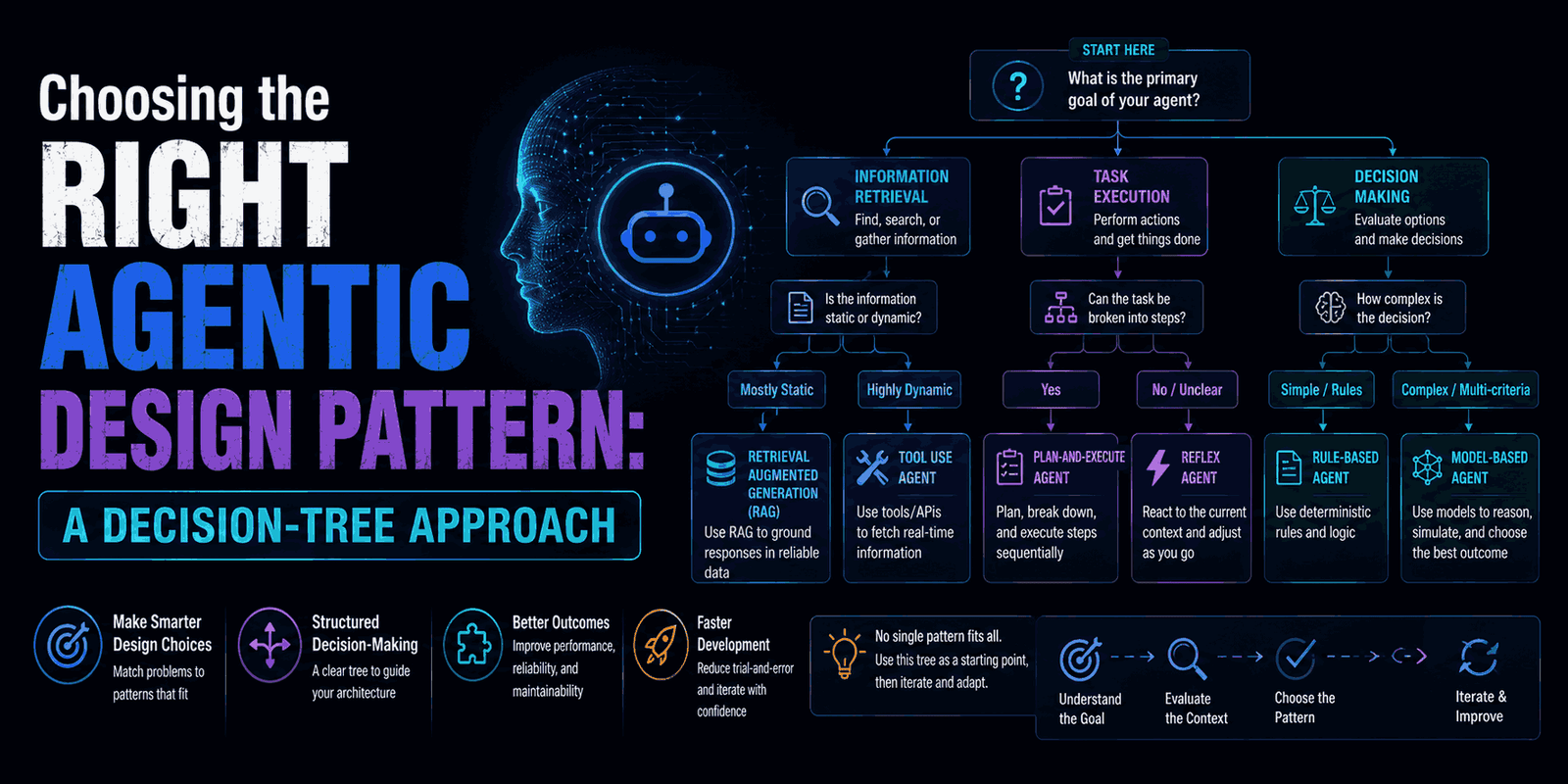
Building an AI system, especially one using large language models (LLMs), is exciting. But how you structure its operations can truly make or break your project. This structure, often called an “agentic design pattern,” determines how your AI agent thinks, acts, and interacts with the world.
It’s not just about picking what looks cool; it’s a fundamental choice that impacts everything from efficiency to how well your AI scales and ultimately, its success. Many headaches start when we misread the task, choosing a pattern that’s either too complex for a simple problem or not strong enough for a tough challenge.
Imagine spending weeks building a multi-agent system when a single, well-designed agent with a few tools could handle the job. Or, conversely, keeping things too simple only to discover in production that your AI can’t adapt, forcing a costly redesign.
In this article, we’ll dive into a structured decision-tree approach to help you confidently pick the best agentic design pattern for your AI system. Here’s what we’ll cover:
- Why pattern selection is crucial for AI development.
- The core ideas behind major AI agent patterns like ReAct, Planning, Reflection, and Multi-agent systems.
- A five-question decision tree that links your specific task needs to the most appropriate starting pattern.
- Common warning signs that your chosen pattern might be failing, along with practical solutions.
It’s all about giving you a clear, principled starting point. This makes the reasoning behind your architectural choices explicit and easy to adapt as your project evolves.
Why Thoughtful Agentic Design Matters for AI Systems
Before we jump into the decision tree, let’s quickly chat about why picking the right AI agent design pattern matters so much. Each pattern isn’t just a different piece of code; it’s built on specific ideas about how to tackle a task.
Think of it like this:
- ReAct (Reasoning and Acting) Pattern: It assumes you can’t always see the next best step right away. This pattern combines reasoning with using external tools at each step to refine decisions. Great for dynamic, uncertain tasks.
- Planning Pattern: It works on the idea that you can map out the main parts of a task early on. Defining an execution roadmap helps improve reliability for predictable, multi-step operations.
- Reflection Pattern: You use it when initial outputs often need a second look. It’s based on the belief that iterative self-critique and refinement can significantly boost final quality, even if it adds a bit of cost.
- Multi-Agent Approaches: It suggests that breaking down a complex task into specialized roles makes things easier. Here, running things in parallel or using a modular approach can outweigh the overhead of coordinating multiple agents.
When your chosen pattern matches your task’s real needs, it adds huge value. But if it doesn’t, you’re just adding unnecessary complexity or cost without better results. For instance, planning can become too rigid if the task’s structure only appears during execution. Reflection might waste resources on simple queries that are usually accurate the first time. And multi-agent setups can be overkill for problems a single agent could easily handle.
The goal is to match the tool to the job. The decision tree we’re about to explore helps you do exactly that, guiding you through key task properties to determine which design approach truly fits.
Your Guide to Agentic Design: A Five-Question Decision Tree
Think of this decision tree as your practical roadmap for picking the right AI agent architecture. It uses five branching questions, each designed to narrow down the best pattern based on what your task actually needs. While AI architectures often change as you build, this tree gives you a solid, reasoned place to begin.
Let’s walk through them, one by one.
Question 1: Is the Solution Path Predictable or Adaptive?
This first question helps us distinguish between tasks with fixed, well-defined procedures and those that require more flexible, adaptive responses.
-
A predictable solution path means you can map out every single step before your AI agent even begins. Think of automated processes like:
- Processing invoices: Extract data → Validate fields → Store information → Send confirmation.
- Employee onboarding: Create accounts → Send welcome email → Assign manager → Schedule orientation.
These are workflows where the sequence of steps is largely the same every time.
-
An adaptive solution path means each step the agent takes depends on previous results or new info that pops up during the process. Tasks like detailed research that follows new evidence, customer support that branches based on user input, or debugging that shifts hypotheses cannot be fully planned in advance.
If the path is known → proceed to Question 2a.
If the path is unknown or adaptive → proceed to Question 2b.
Question 2a (If Path is Predictable): Is This a Fixed, Step-by-Step Workflow?
If you have a known, stable path, the Sequential Workflow Pattern is often perfect. Here, your AI agent follows explicit, ordered steps, passing outputs from one stage to the next until the task is complete.
(Imagine an image of a sequential workflow pattern here)
The trick here is to use your AI model only for the parts that truly need its smarts – like interpreting tricky text or generating creative stuff. For everything else – fixed actions, data handling, or simple logic – stick with traditional code. This keeps your AI system fast, predictable, and cost-effective.
A common mistake? Over-engineering. Don’t throw complex ReAct-style reasoning at every step if the process is already clear and deterministic. If the agent merely needs to execute a sequence, let it execute, not constantly “decide.”
When your fixed workflow starts encountering too many edge cases or needs steps that weren’t initially defined, it might be time to reconsider and move to Question 2b.
Question 2b (If Path is Adaptive or Workflow Breaks): Does Your Agent Need to Interact with the Outside World?
When your solution path is adaptive, the next big question is: Does your AI agent need to talk to the outside world? Does it need to query databases, call APIs, retrieve documents, or execute code? Or can it operate solely on information already within its immediate context?
(Imagine an image of a tool use pattern here)
In almost all real-world AI applications, the answer is a resounding ‘yes’: tool use is essential. An intelligent agent that can only reason over its initial training data and conversation history is limited. The moment your task involves current information, external state changes, or performing actions beyond its internal thought process, integrating tools becomes foundational.
Designing effective tools with clear definitions, inputs, and outputs is crucial for success. However, for choosing a design pattern, the main point is simpler: tools enhance your agent’s capabilities without fundamentally altering its core reasoning pattern. A ReAct agent with tools is still a ReAct agent, just a more capable one. Think of tool use as a foundational layer, powering up your agent’s chosen reasoning style.
Assume tool use is required and move forward to Question 3, unless your task is genuinely self-contained.
Question 3: Can You Map Out the Task Structure Before Starting?
This helps you pick between a Planning pattern and a ReAct pattern. Many developers jump straight to ReAct, but understanding your task’s structure can actually lead to much stronger designs.
The ReAct pattern works by iteratively alternating between a reasoning step (what should I do?) and an action step (let’s do it with a tool). It uses the results of each action to decide the next step, continuing until it knows it’s done.
(Imagine an image of a ReAct pattern here)
A task is structurally articulable when you can break it into clear, ordered subtasks with dependencies before the agent starts working. You might not know every tiny detail, but the main stages and their sequence are clear. Examples include:
- Developing a software feature (Design → Implement → Test → Deploy).
- Producing a research report (Gather information → Synthesize data → Write report → Review).
The Planning pattern shines when this kind of structure exists. It involves an agent first creating a detailed plan or roadmap of steps to achieve the goal. This upfront planning can expose dependencies early and help avoid mid-execution surprises. Without a plan, agents might only discover mistakes after significant time and compute have been spent going down the wrong path.
(Imagine an image of a Planning pattern here)
But planning has downsides. It adds an extra upfront step, heavily relies on the initial plan’s quality, and can make things rigid if real-world conditions don’t match expectations. If the task’s structure only becomes clear through interaction and feedback, a rigid planning approach can be counterproductive.
If the task has a clear, articulable structure → consider a Planning pattern, often with ReAct handling the execution within each planned step.
If the task structure emerges dynamically during execution → opt for a ReAct pattern and move to Question 4.
Question 4: Is High-Quality Output More Important Than Speed?
This brings in the Reflection pattern, which is all about a generate–critique–refine cycle. It helps you decide if this iterative improvement loop should be part of your agent’s core.
(Imagine an image of a Reflection pattern here)
Reflection is particularly useful when two things are true:
- Clear Quality Criteria: There must be explicit standards or criteria against which the output can be checked. This could be verifying a generated SQL query, assessing a written argument’s logic, or ensuring a contract has all key elements.
- High Cost of Errors: The consequences of a flawed first-pass output are significant enough to justify an extra round of processing. Think of deploying code, drafting client-facing documents, or making financial decisions.
Reflection isn’t as helpful if these conditions aren’t there. Without clear criteria, your agent’s “critic” might give vague or unhelpful feedback. Also, if response speed is a priority – for live systems or high-throughput tasks – the added delay of a critique cycle can be a drawback.
A key point for reflection: the critic needs to be somewhat independent. If the critic component is too similar to the generator, it might just agree with the initial output instead of offering meaningful evaluation. Strong reflection often benefits from a distinct framing or even a separate model for the critique phase.
If high-quality output is paramount and some latency is acceptable, with clear evaluation criteria → integrate the Reflection pattern.
If response speed is more critical or evaluation criteria are vague → skip reflection and move to Question 5.
Question 5: Does the Task Demand Specialization or Scale Beyond a Single Agent?
This last question helps you figure out if a Multi-Agent Architecture is truly needed. It’s a big step, so only consider it after you’ve gone through the earlier questions.
(Imagine an image of a Multi-Agent Pattern here)
Multi-agent systems are beneficial when tasks are too complex or large for a single AI agent to handle effectively. They excel in scenarios where:
- Different Expertise is Needed: Various parts of the task require distinct reasoning styles or specialized knowledge, such as legal review combined with financial modeling, or coding alongside security auditing.
- Scale Exceeds Single-Agent Capacity: The workload cannot fit within a single agent’s context window, or the task can benefit significantly from parallel execution to reduce overall completion time.
While multi-agent systems can boost performance by spreading work, they also bring challenges: coordination overhead, more complex shared states, and more potential points of failure.
If you don’t need specialization or massive scale, a single, well-designed agent is usually enough. The added complexity and overhead of managing multiple agents would likely outweigh any benefits. The decision to use a multi-agent system should stem from a clear bottleneck that specialization or parallelism can genuinely solve, not merely architectural preference.
When a multi-agent approach is warranted, key design considerations include defining task ownership for each agent, establishing robust routing logic to direct work, and choosing the right topology (e.g., sequential, parallel, or collaborative debate-style coordination).
By working through these questions, you can arrive at a principled choice for your AI agent’s design.
(Imagine an image of the full decision tree flowchart here)
Mapping Your Decisions to AI Agent Patterns
By following the decision tree, you’ll arrive at one of several common starting patterns for your AI agent. Remember, these are initial architectures, and real-world AI agents often combine elements from multiple patterns as they evolve.
| Resulting Agent Pattern | When to Use | Why It Works |
| :—————————- | :———————————————————————————————————————————————————- | :———————————————————————————————————————————————————————————- |
| Single Agent + Tools + ReAct | Your task has an unknown solution path, lacks clear structure upfront, doesn’t have super strict quality demands (speed is fine), and doesn’t need specialized roles. | This is a flexible default for many real-world tasks. It allows for adaptive exploration with tools and step-by-step reasoning, making it easier to spot issues and improve as you go. |
| Planning Agent + ReAct Execution | The task structure can be largely understood before execution, but individual steps still need adaptive reasoning and tool use during their run. | The planning component defines the overall stages and dependencies, while ReAct handles local uncertainty within each step. This cuts down on mid-execution failures from hidden complexities. |
| Single Agent + Reflection | High-quality output is essential, and you can handle a slightly longer response time. | The Generate → Critique → Refine loop effectively improves correctness and reliability. It works best when you have explicit and verifiable evaluation criteria. |
| Multi-Agent Specialist System | Your task has strong specialization requirements, or its scale and complexity are too much for a single agent to handle efficiently. | A coordinator routes tasks to specialized agents, enabling parallel processing and leveraging specific domain expertise. Just be aware of increased coordination and system complexity. |
Troubleshooting Common AI Agent Design Problems
Choosing an initial pattern is a great first step, but real-world development means you’ll need to recognize when your chosen pattern isn’t performing as expected. Here are some common signals and their targeted fixes:
| Signal | What It Means | Suggested Fix |
| :———————————– | :————————————————————————————————————— | :——————————————————————————————————————————————————————————————————————————————————————– |
| ReAct agent loops excessively | The agent takes too many steps, rehashes old questions, or seems stuck on how to move forward or stop. | Your task probably needs more structure, maybe a Planning pattern. Or, try refining tool descriptions, making stopping conditions clearer, or improving the agent’s internal thought process. |
| Planning agent frequently abandons its plan | A plan is generated, but the agent’s execution constantly deviates from it. | This shows the task is less structured or more dynamic than you first thought. Consider a lighter planning approach, or let ReAct handle more of the dynamic decision-making within broader stages. |
| Reflection cycles don’t improve output | The critique and refinement steps aren’t leading to noticeably better quality in the final output. | The evaluation criteria might be too vague, or the critic agent is too similar to the generator, causing it to agree too readily. Refine the critique prompt, make criteria more explicit, or use a distinct perspective for the critic. |
| Multi-agent system experiences routing failures | Tasks are being sent to the wrong specialist agent, or outputs from different agents don’t combine well. | This often points to issues in your routing logic. Implement more deterministic rules for predictable task allocation instead of relying solely on the LLM for complex routing. Improve the contracts and hand-off mechanisms between agents. |
Why This Structured Approach Matters for AI Development
Using this structured decision-tree approach turns picking your AI agent’s design from a gut feeling into a thoughtful, informed choice. It makes you ask crucial questions about your task’s solution path, its structure, quality needs, and potential for specialization before you even start writing major code. This upfront thinking is golden, because fixing mistakes is always cheapest during the design phase.
Many AI development challenges come from either over-engineering too soon (adding needless complexity) or staying too simple for too long (leading to fragile systems). The underlying agentic patterns are strong; the real trick is picking the right one for your specific needs. Let this decision tree guide your initial choices, and then allow practical experience and performance metrics to guide the ongoing evolution of your AI architecture.
For applications where reliability, safety, or complex judgment calls are paramount, remember to consider incorporating human-in-the-loop checkpoints. This ensures human oversight for the most critical decisions.
Ready to build smarter, more robust AI systems? Start by selecting the right pattern with confidence.
Frequently Asked Questions (FAQ) about Agentic AI Design
What exactly are agentic design patterns in AI?
Agentic design patterns are established architectural blueprints for structuring how an AI agent (especially one powered by a large language model) perceives, reasons, plans, and acts to achieve a goal. They provide a common vocabulary and proven approaches for building intelligent AI systems.
Why can’t I just use the ReAct pattern for every AI task?
While ReAct is incredibly versatile and often a good default, it’s not always the most efficient or effective choice. For tasks with a clearly defined, predictable structure, a Planning pattern can be more reliable and less prone to looping. For simple, fixed workflows, a basic sequential pattern might be sufficient and more cost-effective. Choosing the right pattern avoids over-engineering and unnecessary complexity.
When should I seriously consider building a multi-agent system?
You should consider a multi-agent system when a single AI agent is demonstrably struggling with the task’s complexity, scale, or need for diverse expertise. This could be because the task requires different “specialists” (e.g., a “coder agent” and a “QA agent”), the sheer volume of information exceeds a single agent’s context window, or parallel execution is needed to speed up a complex process.
How do “tools” fit into these different AI agent patterns?
Tools (like API calls, database queries, or code execution) are fundamental capabilities that almost all real-world AI agents need to interact with external systems and access current information. Tool use isn’t typically a design pattern on its own, but rather a capability that underpins and empowers other patterns like ReAct, Planning, and Reflection. An agent uses tools as directed by its chosen reasoning pattern.