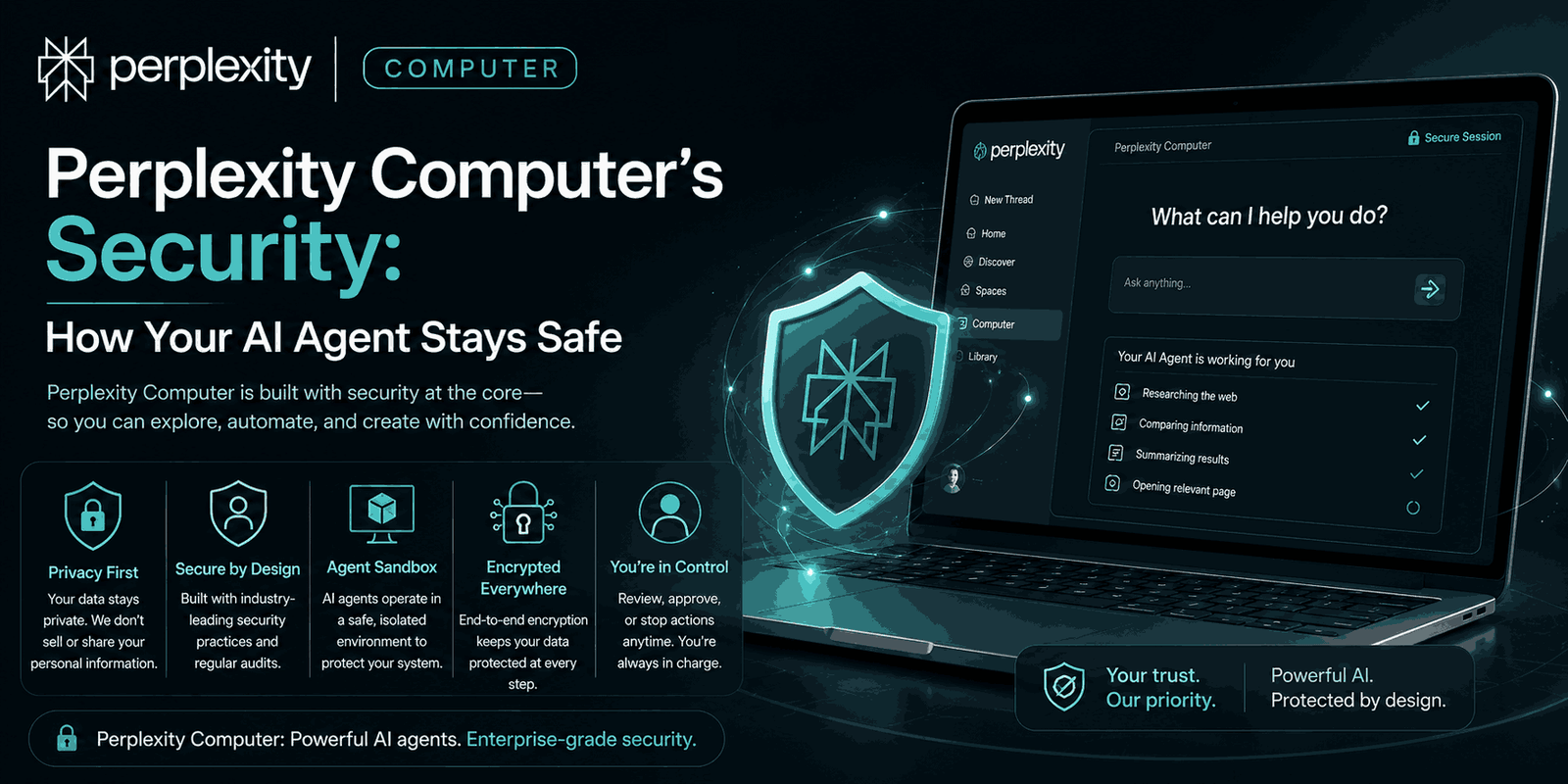
As AI tools get smarter, tackling complex tasks like writing code, browsing the web, and hooking into other services, a big question pops up: How safe are they, really? For businesses and individuals counting on these autonomous agents, understanding their security isn’t just tech talk – it’s crucial for keeping your sensitive data protected and maintaining trust.
Perplexity Computer is one of these powerful autonomous agents, built to handle tasks for you. But when an AI starts running code and interacting with live services, how can you be sure it’s secure? Let’s take a deep dive into how Perplexity has built a solid security framework for Computer, making sure your operations stay safe and private.
What Exactly Is Perplexity Computer?
Think of Perplexity Computer as your super-smart digital assistant, designed to expand what you can do. It’s an advanced autonomous agent that can write and run code, surf the internet to gather information, and integrate with various external services to complete specific tasks. The goal? To automate your workflows and take action, freeing you up for more strategic work.
This powerful tool isn’t built from scratch; it sits directly on Perplexity’s existing infrastructure. This means it inherits a foundational layer of enterprise-grade security features right away, including SOC 2 Type II attestation (verified for 2026). In simple terms, this is a stamp of approval showing it meets high standards for managing your data securely. You also get features like Single Sign-On (SAML SSO), detailed audit logs, and granular administrative controls.
But when an AI can actually run code and touch live services, new security concerns emerge. Perplexity has added specific, extra layers to tackle these challenges head-on.
Key Security Features You Need to Know
To keep your data and operations safe, Perplexity Computer focuses on four main areas: sandbox isolation, careful handling of connectors and data, strong prompt injection defenses, and robust enterprise governance.
1. Sandbox Isolation for Safe Code Execution
Running arbitrary code is always a bit risky. But Perplexity Computer handles this by isolating every single task at a hardware level. Every task runs inside a Firecracker microVM sandbox. This advanced setup ensures “least privilege,” meaning it only has the access it absolutely needs. It goes beyond standard operating system security to create a truly secure environment.
Each microVM is built for maximum isolation:
- Dedicated Kernel: Every session gets its own independent Linux kernel, preventing any mixing with other tasks.
- Isolated Filesystem: Each virtual machine has a clean, isolated filesystem that completely resets once the session ends.
- Private Network Namespace: Sandboxes operate on their own isolated network, complete with dedicated firewall rules, keeping them separate from everything else.
These sandboxes automatically pause when not in use and are destroyed after a period of inactivity. This ensures every new session starts fresh. Crucially, only the necessary credentials for the current task are injected, and these are also destroyed when the sandbox is. Instead of raw API keys, sub-agents use short-lived proxy tokens routed through an authenticated gateway for an extra layer of protection.
Plus, data storage is kept completely separate from code execution, using different cloud VPCs. All communication between these environments is secured with encrypted HTTPS.
2. Secure Connectors and Data Handling
An autonomous agent needs to connect to other services, but it has to do so safely. Perplexity Computer manages these connections with strict controls:
- Scoped Access: Admins can enable or disable specific connectors for their organization, giving them full control. Individual users then authenticate the services they want to use within Computer.
- Controlled Authentication: Built-in integrations (like Google and Microsoft) use standard authentication flows from those providers. Custom remote connectors support secure methods like OAuth 2.0 or enterprise-managed API key authentication.
- Minimal Data Transfer: All connector types are designed to send only the bare minimum data needed to complete a task.
Data handling also follows a stringent model. Remote custom connectors must use HTTPS, and any file connector data is encrypted both while it’s moving (in transit) and while it’s stored (at rest).
Here’s a big one: enterprise data—including your task inputs, outputs, connector data, and sandbox contents—is not used for model training. Any enterprise file attachments you upload are automatically deleted after 7 days.
3. Robust Prompt Injection Defense
One of the trickiest threats to AI agents that browse the web is prompt injection. This is when malicious content on a webpage tries to trick the AI into doing something unintended. Perplexity Computer builds on defenses originally developed for Comet, using a four-layer defense architecture and BrowseSafe, an open-source detection model specifically for browser agent security. These defenses have even been audited by security experts at Trail of Bits.
Here’s how it works:
- ML Classifiers: Machine learning classifiers constantly scan content retrieved from external sources before Computer can act on it. If suspicious content is detected, the system flags it and can trigger a safe stop.
- Continuous Updates: These classifiers are regularly updated based on findings from bug bounty programs, “red team” exercises (where security experts try to hack the system), and real-world detection events.
- Explicit Guardrails: Each tool’s system prompt includes clear rules. External content is always marked as untrusted, and the system continuously refers back to your original user query during tool selection and execution.
- Additional Safeguards: When dealing with untrusted content, Computer applies even stricter prompt handling and model-level protections. This multi-layered approach helps keep the AI from being manipulated.
4. Comprehensive Enterprise Controls
For organizations using Perplexity Enterprise, administrators get powerful governance features to oversee how Computer operates in their environment. This is vital for staying compliant and managing AI at scale.
- Audit Logs: Admins can log key events, including user queries, agent actions, file access, and connector usage. These logs integrate smoothly with leading Security Information and Event Management (SIEM) systems like Splunk, Azure Sentinel, and Datadog. This lets security teams monitor AI activity right alongside their existing infrastructure.
- Access Controls: Flexibility is key. Admins can disable Computer entirely for their organization, or enable it only for specific team members. Individual third-party connectors (like Gmail, Outlook, Slack, GitHub, Notion, Snowflake, Databricks, and Salesforce) can each be enabled or disabled at the organization level. Admins can even restrict which underlying AI models Computer is allowed to use.
- Billing Controls: For managing budgets, admins can set per-seat credit caps, override individual user allocations, configure auto-reload thresholds, and establish monthly limits. Or, they can simply choose not to add credits beyond the included seat allocation.
For all the nitty-gritty details, you can visit the Perplexity Trust Center or refer to the Computer for Enterprise documentation.
Why This Matters for Your Business or Projects
In an era where AI Automation Tools are becoming indispensable, the underlying security infrastructure isn’t just a nice-to-have – it’s an absolute must. Perplexity Computer’s detailed approach to security means:
- Reduced Risk: By isolating tasks, encrypting data, and defending against attacks, the risk of data breaches or malicious AI actions is significantly minimized.
- Data Privacy: Strict data handling policies, like not using enterprise data for model training and deleting file attachments after 7 days, provide real peace of mind.
- Compliance: Achieving a 2026 SOC 2 Type II attestation demonstrates a serious commitment to industry-leading security standards, which is vital for many businesses.
- Trust and Confidence: Knowing that an autonomous agent can perform complex tasks securely builds confidence, allowing businesses to harness AI’s power without undue concern. This directly impacts productivity and efficiency, letting you focus on strategic growth rather than worrying about security vulnerabilities.
Who Should Be Using This?
Perplexity Computer, with its robust security foundation, is particularly well-suited for:
- Businesses and Enterprises: Especially those with strict compliance requirements or handling sensitive data.
- Developers and Engineers: For securely automating coding tasks, script execution, and development workflows.
- Marketers and Researchers: To ensure secure web browsing, data gathering, and content analysis without risking prompt injection.
- IT and Security Teams: Who need granular control, detailed audit logs, and seamless integration with existing SIEM systems.
- Anyone exploring AI Automation Tools: If security and data privacy are top priorities for your AI deployments, this is a strong contender.
Pros and Cons
Like any sophisticated tool, Perplexity Computer offers distinct advantages and some points to consider:
Pros:
- High-Level Security: Features hardware-level sandbox isolation using Firecracker microVMs.
- Strong Data Protection: Encrypts data in transit and at rest, crucially doesn’t use enterprise data for model training, and adheres to strict data retention policies.
- Robust Prompt Injection Defense: Utilizes a multi-layered approach, including ML classifiers and explicit guardrails, with independent audits.
- Comprehensive Enterprise Controls: Offers detailed audit logs, flexible access management, and billing controls for organizations.
- Compliance Ready: Built on infrastructure with a 2026 SOC 2 Type II attestation, meeting high security standards.
- Automates Complex Tasks: Capable of securely writing code, browsing the web, and integrating with external services.
Cons:
- Enterprise Focus: While the extensive security and governance features are a huge benefit for businesses, they might be more than what individual users need for simpler, less sensitive tasks.
- Configuration Overhead: Setting up connectors and access controls for an organization requires some administrative effort, though this is a necessary part of ensuring high security.
Alternatives
While we’re focusing on Perplexity Computer here, it’s worth noting that it operates in the exciting and rapidly growing space of autonomous AI agents. If you’re exploring solutions that automate code execution, web browsing, and external service integration, you’ll find other AI Automation Tools or platforms that allow for custom AI development and integration.
However, a word of caution: it’s absolutely crucial to thoroughly evaluate the security posture of any alternative you consider. Especially when dealing with sensitive data or mission-critical tasks, security implementations can vary wildly between platforms. Always do your homework!
Beginner Tips for Getting Started Safely
Diving into autonomous AI agents can be incredibly exciting. Here are a few beginner tips to help you get started with Perplexity Computer, keeping security top of mind:
- Start Small: Begin with less critical tasks to familiarize yourself with how Computer operates and how it interacts with services. This helps build confidence.
- Understand Permissions: Pay close attention to the permissions requested when setting up connectors. Always grant only the minimum access necessary.
- Review Audit Logs: If you’re an enterprise user, make it a habit to regularly review audit logs. This lets you monitor activity and ensure everything is operating as expected, which is a best practice for any AI Automation Tool.
- Explore the Trust Center: Take some time to read through Perplexity’s Trust Center and enterprise documentation. Understanding the full scope of security features will help you utilize the tool more effectively and safely.
- Craft Clear Prompts: Even with strong defenses, clear and unambiguous prompts are your first line of defense against unintended actions. Be specific!
FAQ Section
Q1: What is Perplexity Computer?
A1: Perplexity Computer is an autonomous AI agent designed to write and run code, browse the web, and connect to external services to complete tasks on your behalf.
Q2: How does Perplexity Computer ensure data security?
A2: It ensures data security through sandbox isolation for tasks, encrypting data in transit and at rest, not using enterprise data for model training, deleting file attachments after 7 days, and providing robust enterprise controls like audit logs.
Q3: What is sandbox isolation in Perplexity Computer?
A3: Sandbox isolation means every Computer task runs inside a Firecracker microVM sandbox, providing hardware-level isolation. Each sandbox has a dedicated Linux kernel, an isolated filesystem, and a private network, all designed to reset after each session.
Q4: How does Perplexity Computer defend against prompt injection attacks?
A4: It uses a multi-layered defense architecture, including ML classifiers to scan external content for suspicious activity, explicit guardrails in system prompts, and continuous referencing of the original user query. It also applies stricter handling for untrusted content.
Q5: What enterprise controls are available for Perplexity Computer?
A5: Enterprise users gain access to comprehensive audit logs that integrate with SIEMs, granular access controls to enable/disable the tool or specific connectors (like Gmail, Slack, Salesforce), and billing controls for managing credit usage and limits.
Final Thoughts
The development of sophisticated AI agents like Perplexity Computer marks a significant leap forward in automation and productivity. But this progress must come with an unwavering commitment to security. Perplexity’s detailed approach, from hardware-level isolation to advanced prompt injection defenses and extensive enterprise controls, shows a clear understanding of these challenges. For any individual or business looking to leverage the power of AI to automate complex tasks, understanding and prioritizing these security measures isn’t just good practice—it’s absolutely essential for a safe and effective digital future.
Want more AI tools, AI blogging tips, and AI money-making guides? Visit MakeDigitalProfits.com