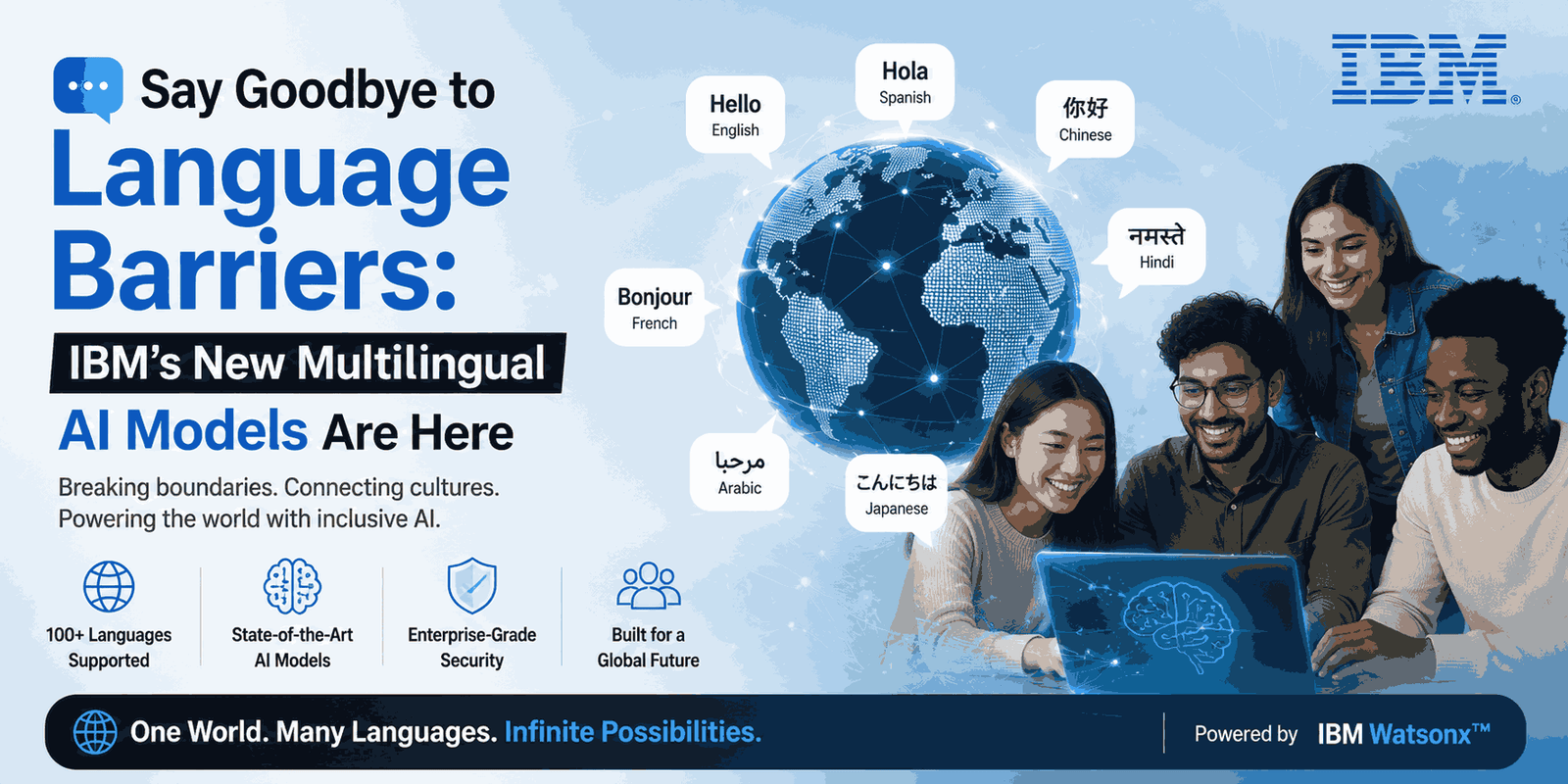
Ever feel stuck when building AI applications that need to handle different languages? It’s a common dilemma: do you pick a huge, slow model that supports many languages or a smaller, faster one that sacrifices coverage? This balancing act is tough, especially for tasks like RAG (Retrieval-Augmented Generation), searching across languages, or even finding code for global teams.
But what if you didn’t have to choose?
IBM just dropped something exciting: the Granite Embedding Multilingual R2 models. These new models are designed to bridge that gap, giving you excellent performance, reasonable size, and broad multilingual support. Let’s take a closer look at why these are a big deal for developers and businesses.
What Exactly Are Granite Embedding Multilingual R2 Models?
Simply put, an “embedding model” takes text and turns it into a numerical code (an “embedding”) that captures its meaning. These codes are vital for AI tasks like finding similar documents, ranking search results, or powering chatbots. When an AI answers your question, it’s often using these embeddings to pinpoint the most relevant information.
The new Granite Embedding Multilingual R2 release introduces two open-source models, both built on the cutting-edge ModernBERT architecture:
- granite-embedding-311m-multilingual-r2: This is the larger model, with 311 million parameters. It creates 768-dimensional embeddings and supports “Matryoshka Representation Learning” (more on that in a bit!). It’s a top performer for multilingual retrieval.
- granite-embedding-97m-multilingual-r2: A compact model with just 97 million parameters, creating 384-dimensional embeddings. Don’t let its size fool you; it still delivers impressive retrieval quality for its class.
Both models are engineered to handle complex multilingual data, giving you efficient and high-quality text representations. The goal? Great performance without needing an unnecessarily huge model.
Key Features That Make a Real Difference
These Granite R2 models aren’t just minor updates; they’ve been rebuilt from the ground up with some serious upgrades:
- Supports Over 200 Languages: They cover a massive range of languages, with specific fine-tuning for improved retrieval quality in 52 of them. This means true global reach for your applications.
- Understands Code, Too: Beyond human languages, they’re trained on programming code from Python, Go, Java, JavaScript, PHP, Ruby, SQL, C, and C++. This makes them powerful for cross-lingual code searches.
- Huge Context Window: This is a big one! They can process up to 32,768 tokens of context. That’s 64 times more than their R1 predecessors. This means the models can understand and embed much longer documents thoroughly, capturing the full meaning.
- Open-Source & Business-Friendly: Released under the Apache 2.0 license, these models are ready for commercial use. IBM has also carefully chosen training data, avoiding datasets with tricky non-commercial restrictions like MS-MARCO.
- ModernBERT Architecture: They use the latest ModernBERT encoder, packing in advancements like alternating attention lengths for long sequences, rotary position embeddings for that massive context window, and Flash Attention 2.0 for faster GPU encoding.
- Efficient Tokenization: New multilingual tokenizers improve efficiency. The 311M model uses the Gemma 3 tokenizer (262K tokens), while the 97M model has a smaller, pruned 180K-token GPT-OSS tokenizer.
- Matryoshka Embeddings (311M Only): This clever feature lets you shrink the 768-dimensional embeddings down to smaller sizes (like 512, 384, 256, or even 128 dimensions) without losing much quality. It’s a game-changer for saving storage and compute costs.
Real-World Uses for Granite R2 Models
The practical uses for these models are vast, especially if you deal with global data or want to improve AI search.
- Multilingual Information Retrieval: Imagine a company needing to search across legal contracts, internal documents, or customer feedback in dozens of languages. These models can accurately pull up relevant info, no matter the original language.
- Better RAG Pipelines: If you’re building Retrieval-Augmented Generation (RAG) systems, these models let your LLM draw context from much broader and longer multilingual sources. This means more accurate and complete answers. Great for making sophisticated [AI blogging guides] or powerful [AI automation tools].
- Cross-Lingual Search: Let users search in one language and get results from documents written in another. This is key for international research, customer support, or e-commerce.
- Code Understanding & Search: For engineering teams around the world, finding relevant code snippets or documentation across 9 programming languages can be a huge productivity boost.
- Long Document Analysis: That 32K context window makes these models perfect for huge documents like legal papers, technical manuals, or research. They can grasp the entire context, not just the beginning, leading to far more accurate embeddings.
- Easy Integration: Both models fit right into popular frameworks like
sentence-transformers,transformers, LangChain, LlamaIndex, Haystack, and Milvus. So, upgrading your current projects is straightforward.
Why These Models Matter for Your Business and Projects
Granite Embedding Multilingual R2 models offer clear advantages, especially if you’re aiming to optimize your AI infrastructure or expand globally.
- Unbeatable Efficiency: The 97M R2 model provides retrieval quality similar to much larger ~300M parameter models, but it’s about 3 times smaller. This means lower costs and faster processing, perfect for resource-limited deployments.
- Superior Long Document Handling: The huge 32K token context window means your AI can now ‘read’ and fully understand entire documents or extensive reports. This greatly boosts retrieval accuracy for long, complex content, which was a major hurdle before.
- Matryoshka Saves Costs (311M): Truncating embeddings without much quality loss means you can drastically cut down storage needs and computational costs for similarity searches. For example, reducing dimensions by 3x (e.g., 768 to 256) only drops retrieval quality by a tiny 0.5 points. This flexibility is great for optimizing your [AI automation tools] or even running some [AI side hustles] more efficiently.
- Broad Language & Code Support: For international businesses or developers on diverse projects, support for over 200 languages and 9 programming languages is a powerful advantage, opening doors to new markets and applications.
- Enterprise-Ready: IBM’s use of carefully managed datasets and an Apache 2.0 license means these models are designed for commercial use, reducing licensing worries and promoting responsible AI.
- Faster Development: Easy integration into popular AI frameworks means developers can quickly implement these advanced features without major code changes.
Who Should Use This?
These models are versatile and can help a lot of different people:
- Developers & AI Engineers: If you’re building apps that need high-quality multilingual or code embeddings, especially for RAG, semantic search, or recommendation systems.
- Businesses with Global Reach: Companies dealing with documents, customer support, or marketing across many languages can use these models for better insights and efficiency.
- Freelancers & Agencies: Building AI solutions for clients who need robust multilingual features or efficient long-document processing. You might even find new ways for [how to make money using AI] by using these.
- AI Enthusiasts & Researchers: Anyone looking to experiment with cutting-edge open-source AI models will find these powerful and accessible.
- Framework Integrators: If you maintain an embedding framework, vector store, or RAG library, these models offer a strong, open-source option with broad multilingual support.
- Students: Learning about advanced NLP and embeddings can be greatly enhanced by experimenting with these powerful models. They could easily be among the [best AI tools for students].
Pros and Cons of Granite Embedding Multilingual R2
Let’s look at the good and the not-so-good.
Pros:
- Excellent Performance-to-Size: The 97M model delivers quality often seen in much larger models, making it very efficient.
- Huge Context Window: The 32K token context handles extremely long documents, a big leap forward.
- Wide Language & Code Coverage: Supports over 200 languages and 9 programming languages, enabling truly global apps.
- Apache 2.0 License: Open for commercial use, offering flexibility and peace of mind.
- Matryoshka Embeddings (311M): Allows flexible dimension reduction, optimizing storage and computation while keeping quality high.
- Easy Integration: Works seamlessly with popular AI frameworks.
- Enterprise-Ready: Designed with IBM-curated datasets and governance processes for reliable deployment.
- CPU-Optimized Options: Comes with ONNX and OpenVINO weights for efficient CPU inference.
Cons:
- Cross-Lingual Trade-offs for 97M: While strong overall, the 97M model shows a slight performance dip on some very specific cross-lingual tasks (like the Belebele benchmark) compared to its R1 predecessor. This is a trade-off for its smaller size. For critical cross-lingual tasks, the 311M model is the better choice.
- Not Always the Absolute Fastest: While much faster than some competitors (like jina-embeddings-v5-text-nano) in terms of throughput, other models (like harrier-oss-v1-270m) might offer a slightly better speed-to-retrieval score balance in certain situations.
Alternatives to Consider
While Granite Embedding Multilingual R2 models are impressive, it’s always good to know what else is out there for your specific needs:
- Smaller Multilingual Models:
multilingual-e5-smallandparaphrase-multilingual-MiniLM-L12-v2are common choices, though Granite 97M R2 significantly outperforms them on MTEB Multilingual Retrieval. - Larger Multilingual Models:
embeddinggemma-300m,gte-multilingual-base,snowflake-arctic-embed-m-v2.0, andjina-embeddings-v5-text-nanoare other models in a similar size range or slightly larger. - Specialized Models:
harrier-oss-v1-270mshows strong results in some benchmarks. OpenAI’stext-embedding-3-small(API only) is another option, but lacks multilingual capabilities in the benchmark provided. - English-Only Focus: If your data is mainly English, IBM also offers Granite Embedding English R2 (149M parameters) and Granite Embedding Small English R2 (47M parameters). These might offer even higher retrieval quality for English tasks at a smaller size, and are often among the [best free AI tools] for English-specific projects.
Beginner Tips for Getting Started
If you’re new to embedding models or looking to integrate these, here are some easy tips:
- Start with the 97M Model: For most general multilingual tasks,
granite-embedding-97m-multilingual-r2offers a fantastic balance of performance and efficiency. It’s lighter and quicker to deploy. - Use
sentence-transformers: This library makes working with these models incredibly simple. Just a few lines of Python code, and you’re ready to encode text and find similarities. - Explore Framework Integrations: For bigger projects, try integrating these models directly into LangChain or LlamaIndex. This makes building advanced RAG pipelines much easier.
- Experiment with Matryoshka (311M): If you go with the 311M model, play around with shrinking the embeddings. It’s a powerful way to reduce resource use without losing much quality, ideal for optimizing storage or speeding up searches.
- Test with Your Own Data: Always evaluate the models with your specific mix of languages and document types to ensure they meet your project’s unique needs.
- Read the Docs: IBM provides detailed model cards on Hugging Face with full deployment examples and a technical report. Don’t hesitate to dive in!
These models offer a flexible and powerful base for all sorts of projects, from simple text search to complex [AI side hustles].
FAQ Section
Q1: What are embedding models, and why are Granite Embedding Multilingual R2 models important?
Embedding models turn text into numerical codes (vectors) that capture its meaning. This helps AI understand context, find similarities, and perform smart searches. The Granite Embedding Multilingual R2 models are crucial because they provide high-quality embeddings across over 200 languages and programming code, feature an incredibly large context window, and come with an open Apache 2.0 license. They finally solve the old problem of having to choose between model size and wide multilingual coverage.
Q2: What’s special about the 32,768-token context window?
The 32,768-token context window is a huge step forward because it lets these models process and understand very long documents completely, rather than just the first few paragraphs. For tasks involving things like legal contracts, research papers, or detailed technical manuals, this means a dramatic improvement in how accurately they can retrieve information and understand the full context of a document.
Q3: Which Granite R2 model should I choose for my project?
- For the best multilingual retrieval quality, flexibility with Matryoshka dimensions, or top-tier cross-lingual transfer across many language pairs, pick
granite-embedding-311m-multilingual-r2. - For maximum speed, deployment on edge devices, or lower latency, choose
granite-embedding-97m-multilingual-r2. - If your data is mostly English, consider the dedicated English models:
granite-embedding-english-r2orgranite-embedding-small-english-r2.
Q4: Is Granite Embedding Multilingual R2 suitable for commercial use?
Yes, absolutely. Both models are released under the Apache 2.0 license, which is a very permissive open-source license perfect for commercial applications. IBM has made it clear they avoid datasets with non-commercial restrictions, like MS-MARCO, and use strict data governance to minimize risks for enterprise use.
Q5: How do Matryoshka embeddings work in the 311M model?
Matryoshka Representation Learning allows you to take the 311M model’s full 768-dimensional embeddings and “cut them down” to smaller sizes (like 512, 384, 256, or 128 dimensions) with only a tiny loss in retrieval quality. This is super helpful for saving storage space in vector databases and speeding up similarity calculations, as smaller vectors need less memory and processing power. For instance, reducing to 256 dimensions means a 3x cut in storage and computation, with only a 0.5-point drop in performance.
Final Thoughts
IBM’s new Granite Embedding Multilingual R2 models are a significant leap for anyone working with AI, especially in a global setting. By offering high-performing models that are both compact (97M) and full-featured (311M with Matryoshka), along with an extensive context window and an open-source license, IBM has addressed many long-standing challenges in multilingual AI development.
These models offer real, practical benefits—from making long-document retrieval more accurate to powering more efficient cross-lingual applications. Whether you’re a developer integrating AI, a business expanding globally, or just someone exploring [how to make money using AI], the Granite R2 family provides powerful tools ready for real-world deployment. Go ahead, give them a try and see what they can do for your projects!
Want more AI tools, AI blogging tips, and AI money-making guides? Visit MakeDigitalProfits.com