The world of artificial intelligence is moving incredibly fast. New models, agents, and strategies seem to pop up every other week. While many of us had our eyes on Google I/O for their big reveals, the AI scene as a whole keeps changing rapidly. It’s a fascinating mix of innovation, tough competition, and even some strategic shifts in talent.
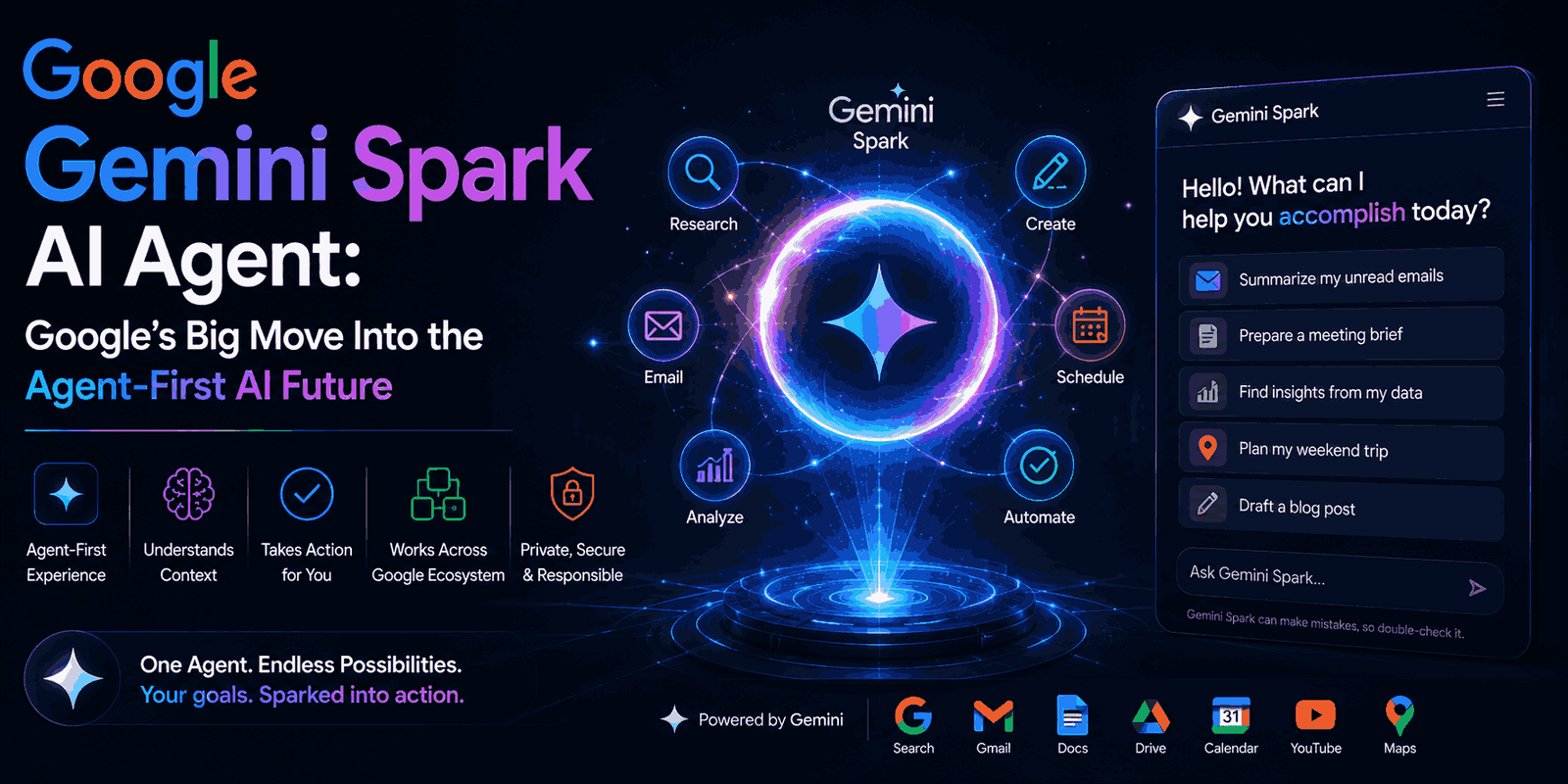
Google’s recent I/O event certainly brought some updates. But for many, the most interesting announcement was the introduction of Gemini Spark, Google’s personal AI agent. This isn’t just another chatbot; it’s being positioned as a 24/7 assistant, designed to weave itself right into the Google Workspace ecosystem. Gemini Spark clearly shows Google’s serious intent to be a major player in the growing personal AI agent space, directly tackling capabilities we’ve seen from competitors.
Google’s Latest AI Push: Gemini Spark and Beyond
Google’s I/O announcements, while some observers didn’t call them “groundbreaking,” definitely highlighted their ongoing commitment to AI innovation. The main focus was on their Gemini family of models and this new personal agent.
Introducing Gemini Spark: Google’s Personal AI Agent
Google is calling Gemini Spark their answer to the “OpenClaw” concept – which essentially refers to advanced personal AI agents emerging from rivals. Gemini Spark aims to be an ever-present, smart assistant. Details are still a bit under wraps with a “coming soon” tag, but the vision is clear: a deeply integrated agent that can automate tasks, manage information, and offer proactive help throughout your digital life within Google Workspace. This move into always-on personal agents is a big one for Google, emphasizing autonomy and smooth integration into our daily work.
Beyond Spark: Other Key Gemini Updates
Besides the exciting prospect of Gemini Spark, Google also shared updates to its core models:
- Gemini Omni Flash: This new model family is all about versatile input and output, kicking things off with video generation and editing. Its technical foundation suggests a big leap in multimodal AI – meaning AI that can handle different types of data like text, images, and video – showing Google’s ambition for truly universal AI interactions.
- Gemini 3.5 Flash: An upgraded version of their general model, Gemini 3.5 Flash promises more speed and intelligence than its 3.1 Pro predecessor. However, its January 2025 knowledge cutoff and pricing changes hint at a more specific role, perhaps for certain enterprise or developer needs. A 3.5 Pro version is expected soon, which could offer even more refinements.
AI Coding with Antigravity
Google also showcased Antigravity, an AI coding agent that offers capabilities similar to tools like OpenAI’s Codex. Designed to help developers, Antigravity aims to make coding workflows smoother. While it’s noted as usable, some early feedback points to minor friction, especially around permission bypasses, though the optional IDE installation does offer flexibility. This entry shows just how competitive the market for AI-powered developer tools is.
The Broader AI Agent Ecosystem: Key Player Moves
Google’s updates land in a rapidly changing competitive landscape, filled with significant developments from other major AI players.
Anthropic’s Ascendancy and Talent Acquisition
Anthropic, a top competitor, recently made headlines by bringing on Andrej Karpathy, a prominent figure in AI research. He’s joining their pre-training team with a fascinating mission: to use existing Claude models to speed up the pre-training of new Claude models – a clever example of AI bootstrapping AI. This move highlights Anthropic’s aggressive pursuit of top talent and its innovative approach to model development.
Financially, Anthropic is projecting impressive figures, including $10.9 billion in June quarter revenue and their first operating profit. This fuels speculation that their valuation could soon surpass OpenAI. This growth is backed by massive compute power, as evidenced by SpaceX’s IPO filing, which disclosed a staggering $1.25 billion monthly payment from Anthropic for compute resources.
OpenAI’s Advancements and Compute Strategy
OpenAI continues its own path of innovation. They recently announced that one of their models successfully solved a famous mathematical problem, a feat externally verified by mathematicians. This really shows AI’s growing capability in complex reasoning. Furthermore, OpenAI introduced a public image verifier for AI-generated images, supporting C2PA metadata and Google’s SynthID. This helps address crucial concerns around content provenance and authenticity.
In a significant move for enterprise users, OpenAI also launched a “Guaranteed Capacity” program. This allows companies to pre-book compute resources for up to three years. The idea is to prevent service slowdowns during demand spikes, ensuring critical AI agents and products remain consistently operational.
New AI Tools and Agent Innovations
Beyond the big players, a lively ecosystem of specialized AI tools and agents keeps emerging. These tools are designed to address specific industry needs and workflow challenges.
Design, Compliance, and Workflow Agents
- Figma’s Design Agent: Integrated directly within the canvas, this agent empowers designers to generate multiple design directions, perform bulk edits, and stick to design systems – all while collaborating in real-time. This is a big step towards AI-augmented creative workflows.
- Neimo MCP: Created for product developers, Neimo MCP acts as a regulatory expert. It leverages models like Claude, OpenAI’s Codex, and Manus to help navigate compliance across over 200 jurisdictions globally. This tool truly shows AI’s growing role in complex, domain-specific tasks.
- Handinger: This platform lets users build AI agents using plain English and connect them to their existing tools, effectively automating tedious administrative work.
- Granola Briefs: An intelligent assistant that sifts through emails, web content, and meeting notes to provide concise, three-bullet summaries before meetings, boosting preparation and efficiency.
- Taste MCP: Explores the concept of design preferences that follow users across various coding and design environments like Codex and Claude Code, promising a more personalized creative experience.
Developer Tools and Frameworks
The developer community is seeing a surge in AI-powered tools aimed at streamlining coding, debugging, and project management:
- Antigravity (Google): As mentioned, Google’s entry into AI coding agents.
- Factory’s Deferred Context Engine (Droid): This tool significantly cuts context size by selectively loading tools, making AI agents more efficient and reducing computational overhead.
- Lapdog (Datadog): Provides local tracing for reasoning and tool calls within popular AI coding assistants like Codex, Claude Code, and Pi, offering deeper insights into agent behavior.
- Roughdraft: An open-source, local interface for commenting and suggesting changes on markdown documents, enhancing collaborative content creation.
- DiffsHub: A clever utility that virtualizes and inspects large GitHub diffs quickly by simply changing a URL, improving code review efficiency.
- Active Graph: An open-source framework designed for long-running agents, enabling them to remember past interactions, react to new events, and compare different operational runs, leading to more robust and persistent AI.
The Competitive Landscape: What This Means for AI
All these announcements and strategic moves paint a picture of intense competition and rapid specialization within the AI industry. While Google pushes its Gemini models and the promising Gemini Spark personal AI agent, Anthropic shows formidable growth and compute ambition. And OpenAI continues to break intellectual barriers while strengthening enterprise support. The sheer volume of new, specialized AI tools – from design to compliance to coding – indicates a maturing ecosystem where AI is being tailored for increasingly specific and impactful applications.
Why Agent-First AI is the Future
A recurring theme across many of these updates is the rise of the “agent-first” approach. Whether it’s Google’s Gemini Spark, an AI coding assistant, a design agent, or a regulatory expert, the future of AI seems to lie in autonomous, specialized, and highly integrated agents. These agents go beyond simple conversational AI. They take initiative, execute complex tasks, and work seamlessly across platforms to truly enhance human capabilities. This shift promises a future where AI isn’t just a tool, but a proactive partner in our digital lives and work.
FAQ
Q1: What is Google Gemini Spark?
A1: Google Gemini Spark is Google’s upcoming 24/7 personal AI agent. It’s designed to integrate across Google Workspace, aiming to provide proactive assistance, automate tasks, and manage information autonomously. It marks Google’s entry into the advanced personal AI assistant market.
Q2: How does Gemini Omni Flash differ from previous Gemini models?
A2: Gemini Omni Flash is the first in a new model family from Google focusing on “any input/any output” capabilities, starting with video generation and editing. This highlights its multimodal nature and versatility beyond traditional text-based interactions.
Q3: What makes Anthropic a strong competitor to OpenAI and Google?
A3: Anthropic shows strong growth, significant talent acquisition (like Andrej Karpathy), and massive investments in compute power (e.g., $1.25 billion monthly from SpaceX for compute). Their focus on safe, reliable AI models and impressive financial projections position them as a formidable rival.
Q4: What is the significance of “agent-first world” in AI?
A4: An “agent-first world” refers to an ecosystem where AI moves beyond simple chatbots or tools. Instead, AI becomes autonomous, proactive agents that can understand context, make decisions, execute multi-step tasks, and integrate across various digital environments to assist users without constant prompting.
Final Thoughts
The current pace of AI innovation is exhilarating, with every major player staking their claim in critical areas. Google’s Gemini Spark personal AI agent, along with advancements in the broader Gemini family, shows a strategic push into integrated, intelligent assistance. Meanwhile, competitors like Anthropic and OpenAI continue to innovate rapidly, backed by significant investments and talent. The array of specialized AI agents emerging further solidifies the vision of an “agent-first” future, where AI doesn’t just respond but actively contributes to our productivity and creativity. Keeping an eye on how these agents evolve and integrate will be key to understanding the next phase of AI adoption.
For those navigating this rapidly evolving landscape, understanding the capabilities of these new AI agents and models is crucial. Stay informed, experiment with the latest tools, and prepare for a truly agent-augmented future.