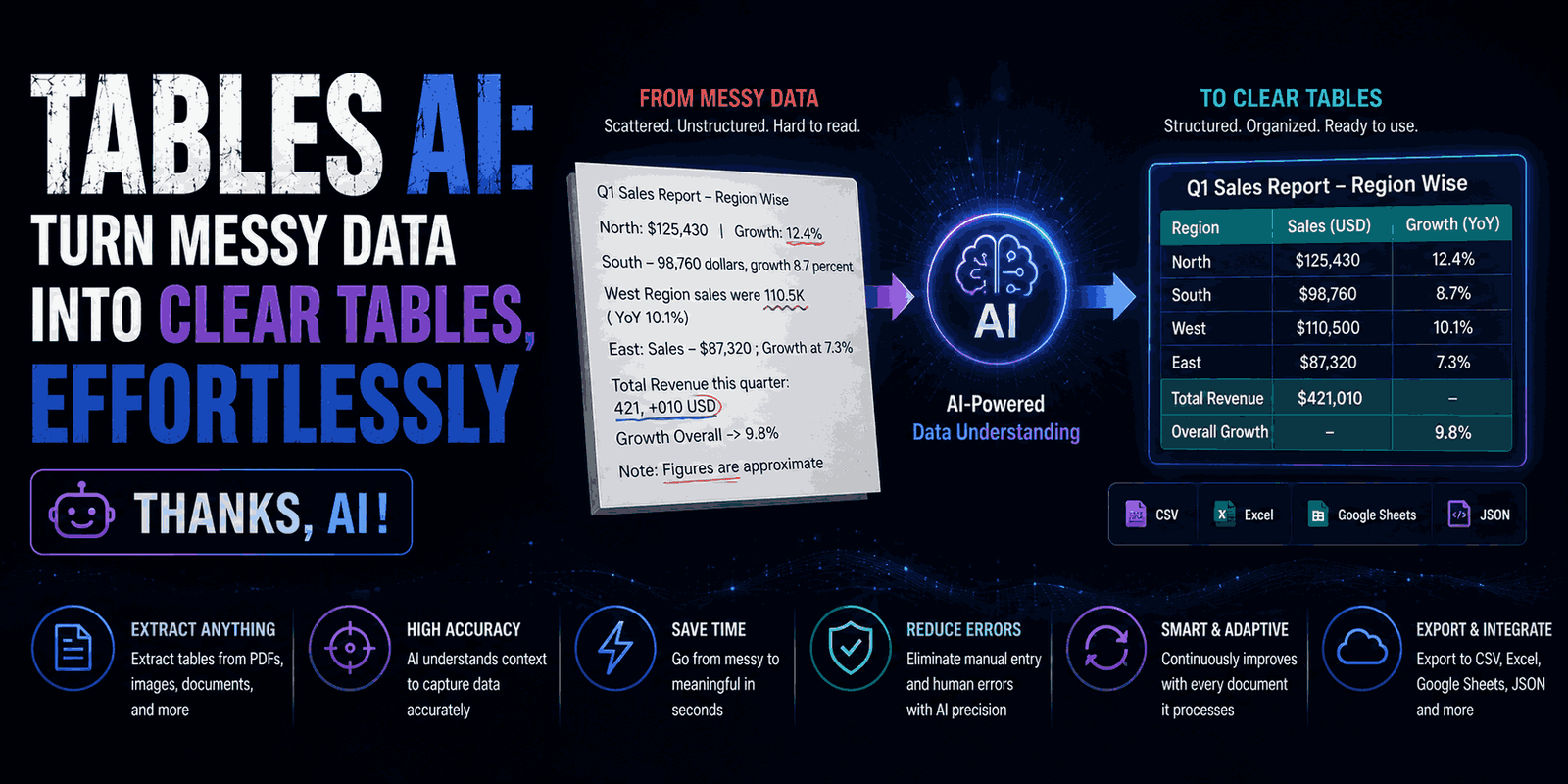
In today’s super-fast digital world, we’re all drowning in information. Seriously, think about it: emails, customer chats, reports, social media posts—they’re packed with potential insights, but they’re often a jumbled mess. We call this “unstructured data.” Trying to analyze it manually? That’s a headache nobody needs.
This is exactly where AI tools for data transformation shine. They bridge that huge gap between raw, messy info and clean, structured data that’s actually ready for action. One cool tool that’s making waves in this space is Tables. It’s an AI-powered platform designed to make this complex process surprisingly simple.
What’s Tables (The AI Tool)?
Think of “Tables” as your personal data organizer. It’s an AI solution built specifically to grab unstructured data – things like free-form text or documents – and neatly arrange it into rows and columns, just like a spreadsheet or a database.
This transformation is a game-changer. Why? Because structured data is a breeze to analyze, search through, and connect with your other systems. It’s the essential groundwork you need to actually understand your data and make smart, informed decisions.
Smart Data Transformation: Key Features That Matter
Tables isn’t just about making tables; it’s about making your data prep workflow easier and better. Here’s a look at what it brings to the table:
Turns Unstructured Data into Tabular Format
At its heart, Tables is brilliant at taking all sorts of unstructured data—text documents, emails, notes, reports—and intelligently pulling out the important bits. Then, it organizes everything into a clean, row-and-column structure. This means way less manual typing and formatting for you.
Creates Actionable Tables for Real Analysis
The goal here isn’t just any table, but one you can actually use. Tables focuses on generating structured data that’s immediately ready for analysis. This ensures your output isn’t just organized but genuinely helpful for your business intelligence, reports, and overall strategy.
Automates Data Transformation, Saving You Hours
One of the biggest wins with tools like “Tables” is the automation. Imagine not having to spend countless hours manually extracting info and painstakingly putting it into spreadsheets. The AI handles the heavy lifting, freeing up data analysts and business folks to actually interpret the data, instead of just preparing it.
Cleans and Fixes Messy Data as It Goes
Raw data is rarely perfect. It often has errors, duplicates, or weird formatting. Tables has built-in features that spot and fix these issues automatically while it processes your information. The result? Better quality data, leading to more reliable analysis.
Plays Nicely with Your Existing Tools
For data to be truly valuable, it needs to flow seamlessly into the tools you already use. Tables is designed to integrate smoothly with various analytics platforms and business intelligence dashboards. This means your newly structured data can quickly be used for cool visualizations and reports.
Who Needs AI-Powered Data Tables? Real-World Examples
So, who can actually benefit from a tool like Tables? Plenty of folks across different industries:
- Market Researchers: Imagine easily sifting through customer feedback from surveys, reviews, or social media to spot trends and understand sentiment.
- Customer Service Teams: Organize messy support tickets or chat transcripts to quickly identify common problems and improve service.
- Financial Analysts: Pull specific data points from complex financial or legal documents that aren’t in a standard spreadsheet format.
- Healthcare Professionals: Structure clinical notes or patient feedback for research or administrative tasks.
- Operations Managers: Consolidate info from various internal reports or logs to track performance and find bottlenecks.
Basically, if you deal with lots of text-heavy or semi-structured data, automating the process of turning it into a usable table can be a huge time-saver.
Why Structured Data is a Must-Have for Your Business
Having your data in a clean, structured table format isn’t just nice to have; it’s fundamental.
- Smarter Decisions: Organized data leads to more accurate analysis, which in turn means more informed and effective business choices.
- Boosted Efficiency: Automation drastically cuts down on the manual work of data prep, saving you precious time and resources.
- Better Data Quality: Automated cleaning and consistency checks reduce errors, making your data more trustworthy.
- Deeper Insights: When data is structured, it’s much easier to spot patterns, trends, and oddities that might otherwise stay hidden.
- Scalability: AI tools can handle way more data than manual processes, making them perfect for growing businesses.
Now, while there are tons of benefits, remember that no AI is magic. The quality of your output still depends on how clear your original input is, and a human eye is always important for really complex or ambiguous data. But for streamlining repetitive tasks and handling bulk data, these tools offer massive advantages.
FAQ About AI for Data Tables
What kinds of messy data can AI actually handle?
AI tools like Tables are pretty versatile. They can typically process various types of unstructured data, including text documents, emails, PDFs, web pages, social media posts, chat logs, and even scanned documents. They do this by identifying patterns and pulling out key pieces of information.
Is AI data transformation good for small businesses?
Absolutely, yes! Small businesses often have limited staff for manual data entry and analysis. AI tools can level the playing field, giving even smaller teams access to advanced data processing so they can get insights from their data efficiently.
How does AI clean up and fix data inconsistencies?
AI uses smart algorithms to pinpoint common data issues like duplicate entries, missing values, inconsistent formatting (think different date styles), and even misspellings. It then applies preset rules or learns patterns to correct these problems automatically.
What do you mean by “actionable tables”?
Actionable tables are structured datasets that aren’t just organized; they’re immediately ready to be used for specific business goals. This could be generating reports, building dashboards, feeding into machine learning models, or directly informing strategic decisions.
Final Thoughts
Being able to quickly and accurately transform raw, unstructured information into clean, actionable tables is a huge leap forward in data management. Tools like Tables empower organizations to unlock the hidden value in their data, leading to better insights and smoother operations. By automating the often tedious parts of data preparation, AI allows teams to focus on what truly matters: understanding their data and using it to drive growth.
Ready to make your data transformation process a breeze? See how platforms like Tables can help you turn your messy data into a structured, valuable asset.