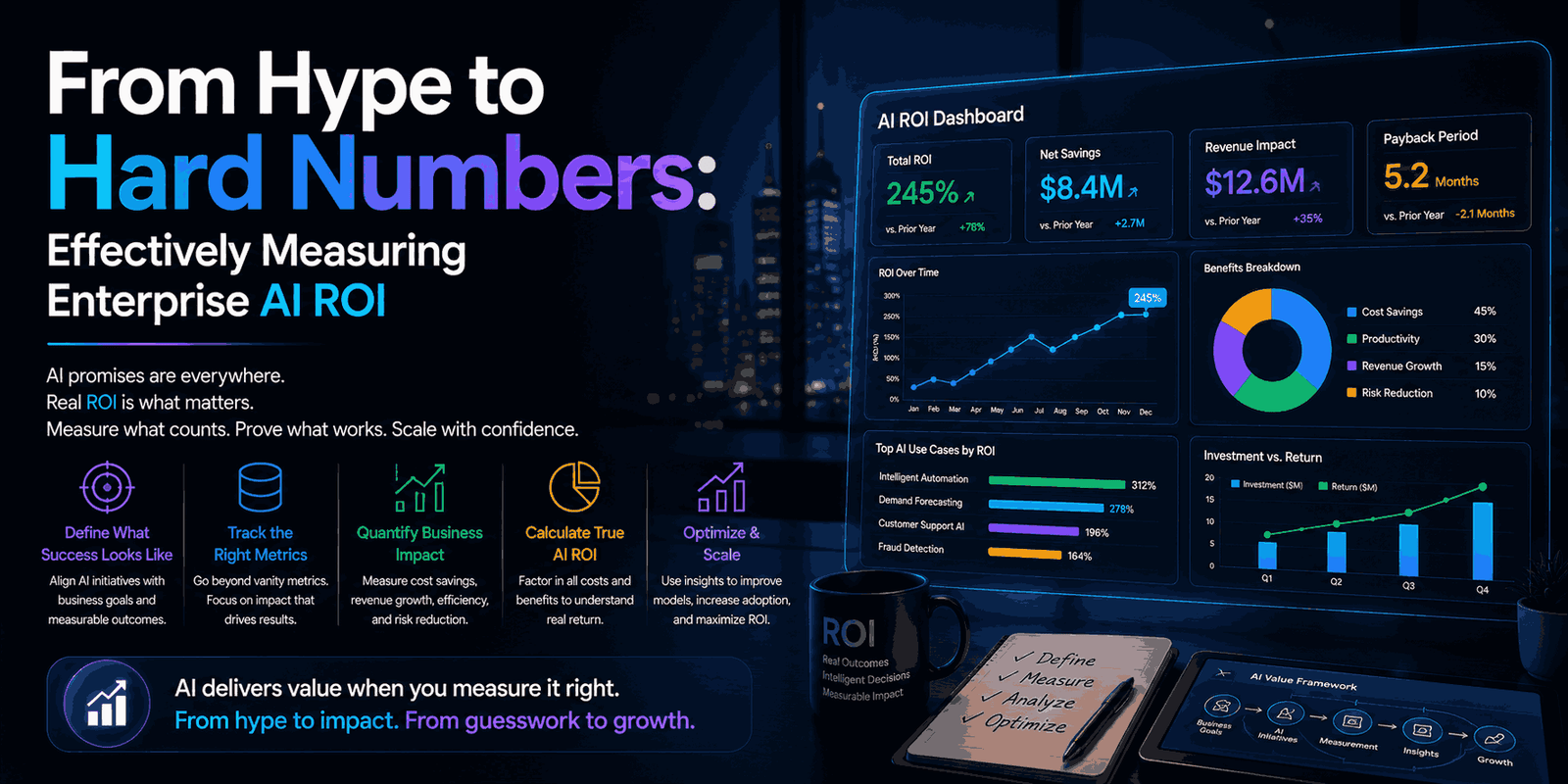
For a while now, Artificial Intelligence has been the talk of the town, promising incredible breakthroughs and capabilities. We’ve seen mind-blowing advancements, from advanced language models to complex automation systems. But as companies pour billions into AI projects, a big question is emerging: how do we actually measure the return on investment (ROI) for these huge AI commitments? The conversation is shifting from “what AI can do” to measuring enterprise AI ROI and proving its real business value.
It used to be all about experimenting and pushing the limits of what AI could achieve. Now, with serious money being spent, rising operational costs, and fierce competition for AI talent, businesses are under more pressure than ever. They need to show concrete results. It’s no longer enough to just adopt AI; companies need to make it work efficiently and turn those investments into measurable profits.
The Real Price Tag of AI: More Than Just the Initial Cost
The sheer scale of AI investment is staggering. Companies aren’t just buying fancy software; they’re investing heavily in physical infrastructure. Think high-performance GPUs, expanding data centers, and the huge amount of energy needed to power it all. This “industrial-scale buildout” is a long-term commitment.
Look at NVIDIA, for instance. Their impressive revenue growth isn’t just about selling chips. It reflects the massive demand from huge tech companies (hyperscalers) and other businesses building out this crucial AI infrastructure. This shows the industry truly believes in AI’s future, but it also highlights the monumental costs involved.
However, the expenses go way beyond just hardware. Businesses are discovering that operationalizing AI comes with hidden, and often substantial, costs. This pressure is starting to affect company profits and even workforce decisions. Meta, for example, saw its stock drop after warning of higher AI-related costs. They then cut thousands of jobs, even while continuing to invest heavily in AI development. This shows the tough balancing act companies face: investing for the future while managing today’s financial realities.
The Big Shift: From What It Can Do to What It Does for Business
The next phase of enterprise AI adoption won’t be about launching the newest model or an exciting new feature. Instead, it will depend on whether these huge investments actually create sustainable, measurable business value. This means looking closely at:
- Operational Efficiency: How is AI making processes smoother, reducing manual work, or speeding up workflows?
- Revenue Generation: Is AI directly helping create new products, services, or boosting sales?
- Cost Reduction: Where is AI cutting expenses? Think customer service, logistics, or how resources are used.
- Talent Optimization: How is AI making human employees more effective and improving overall productivity?
This push for accountability is driving strategic decisions across the industry. Companies aren’t just buying AI applications; they’re also acquiring AI talent through strategic buyouts. This clearly signals that human expertise in getting AI up and running is just as vital as the technology itself.
Key Trends Shaping AI’s Business Impact
The demand for real ROI is influencing many parts of the AI world:
- AI-Powered Workflow Automation: Businesses are increasingly using AI to automate repetitive tasks, boost efficiency, and seamlessly integrate AI tools into their daily work. This renewed interest in workflow automation directly addresses the need for measurable productivity gains.
- Better Discovery & Personalization: Platforms like Google Ads are adding advanced AI features to help businesses show up more in AI-generated search results, opening new ways to find customers and enter markets.
- Enterprise Adoption Changes: We’re seeing shifts in which AI models are gaining traction in businesses. Companies like Anthropic are reportedly surpassing older players in business adoption, suggesting a preference for models that prove their usefulness in workplace and developer tasks.
- Specialized AI Agents: The competition in agentic AI — AI systems designed to handle specific, complex tasks on their own — is heating up. New tools like xAI’s Grok Build, made for coding, aim to deliver specialized, high-impact capabilities that justify the investment.
- Strategic Talent Management: The intense competition for AI talent means that IT leaders (CIOs) and HR leaders (CHROs) need to work closely together. Keeping top AI professionals and managing the workforce changes caused by AI adoption are becoming crucial for successful deployment.
- Industrial Automation: The growth of industrial AI automation, like thousands of robots being deployed in factories, shows how AI is changing traditional manufacturing. This promises significant improvements in efficiency and output.
Why Proving AI’s Value Matters Now More Than Ever
This current stage of AI adoption marks a mature point for the technology. It’s moving past the initial “wow” factor into a practical era where every dollar spent needs to be justified. For businesses, this means creating clear plans for AI implementation, setting solid metrics for success, and encouraging teamwork across departments to truly weave AI into the core of their operations.
The companies that succeed will be those that can clearly explain not just what their AI does, but what concrete value it consistently delivers. This shift will separate true AI innovators from those simply following the tech hype.
FAQ: Understanding AI Investment ROI
Q1: What does “operationalizing AI” mean in a business context?
Operationalizing AI means successfully integrating AI models and systems into a company’s daily business processes. It ensures they run efficiently, reliably, and deliver consistent value. It’s about taking AI from test projects to ready-to-use, scalable solutions.
Q2: Why are enterprises finding it challenging to measure AI ROI?
Measuring enterprise AI ROI can be tough for several reasons: AI systems are complex, it’s hard to separate AI’s impact from other business changes, there are significant upfront investment costs, some benefits are long-term, and there’s often a lack of clear ways to measure intangible benefits.
Q3: What are some key metrics businesses can use to measure AI’s impact?
Good metrics include cost savings (like less labor or better resource use), revenue growth (such as increased sales or new products), efficiency gains (faster processing, improved accuracy), higher customer satisfaction, better employee productivity, and enhanced decision-making.
Q4: How does AI infrastructure spending relate to ROI?
Spending on AI infrastructure (like GPUs, data centers, energy) is a fundamental cost. While necessary for AI, it must be balanced with the expected returns. High infrastructure costs can delay or reduce ROI if the AI applications running on them don’t generate proportional business value.
Final Thoughts
The AI landscape is always changing, with new breakthroughs almost daily. But as the industry matures, the focus has strongly shifted to accountability. Measuring enterprise AI ROI is no longer an afterthought; it’s a key driver for investment and strategy. The winners in this new era will be the organizations that can move past fascination to careful financial and operational validation, showing AI’s clear impact on their bottom line and consistent growth.
Ready to explore how AI can deliver real value for your business? Dive deeper into our [AI resources] and stay informed on the latest trends shaping enterprise AI adoption.