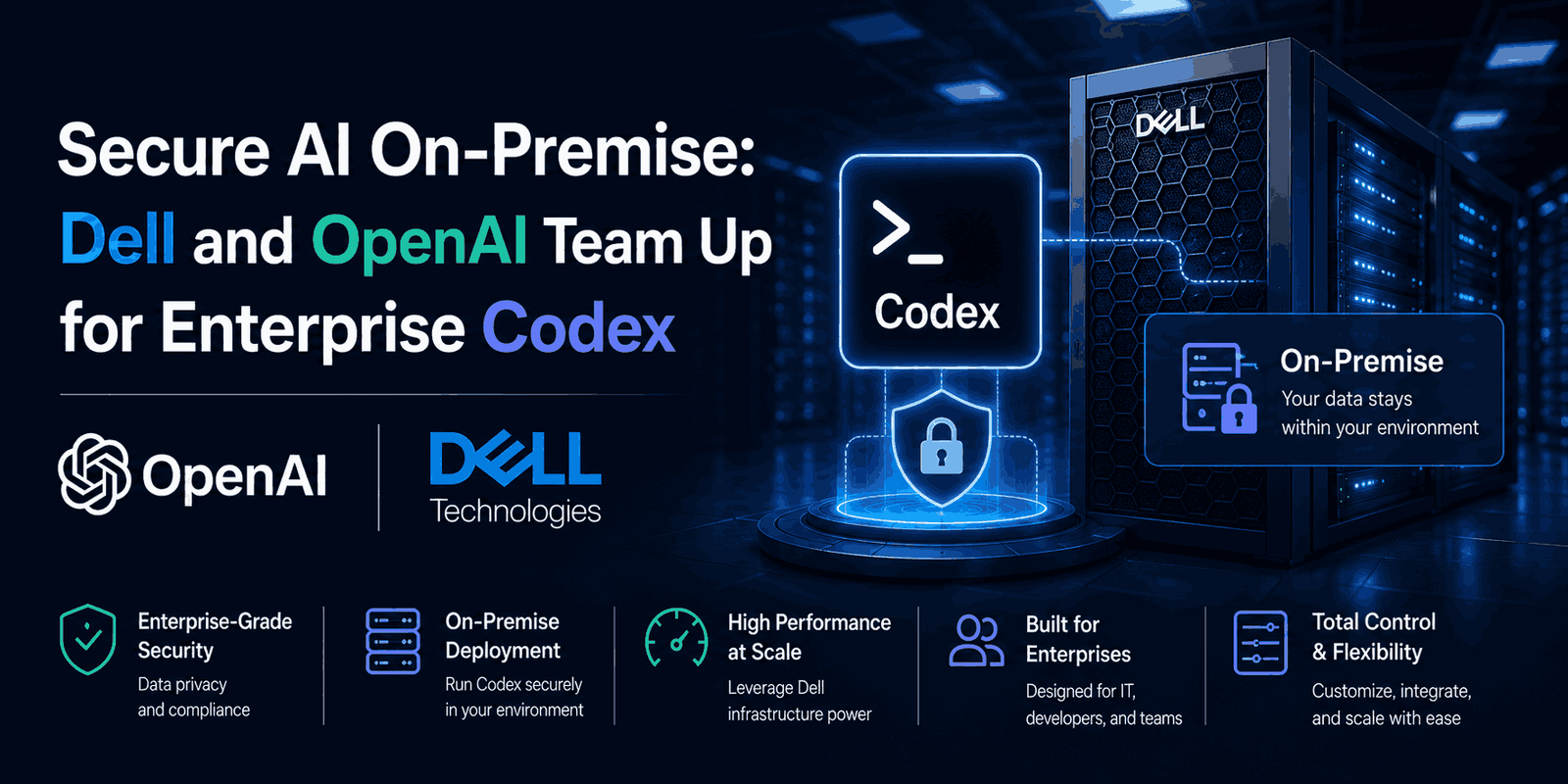
Businesses everywhere are eager to use artificial intelligence. But there’s a big challenge: how do you safely use advanced AI models with your company’s private data, especially when that data has to stay within your own systems? This usually points to hybrid or on-premise solutions. And that’s exactly where the new partnership between OpenAI and Dell Technologies comes in.
This collaboration is all about making powerful AI both accessible and secure for large organizations. By bringing OpenAI’s smart Codex model closer to your existing data, systems, and workflows, Dell and OpenAI are making it much easier for companies to adopt and scale AI solutions with confidence.
Why Keeping AI On-Premise is a Game Changer for Businesses
For many companies, particularly those in regulated industries, data security, privacy, and staying compliant aren’t just important — they’re essential. Storing and processing sensitive information in public cloud environments can be a concern. That’s why on-premise and hybrid cloud strategies are so valuable.
When AI models and the data they use stay within your company’s own data centers or a controlled hybrid setup, you get several key benefits:
- Better Security: Your data remains entirely under your company’s direct control.
- Easier Compliance: It’s simpler to meet specific industry rules (like GDPR or HIPAA).
- Faster Performance: Processing data locally means less lag time for AI tasks.
- Predictable Costs: You have more control over your infrastructure spending.
This new partnership directly addresses these crucial needs. It offers a solution that prioritizes control and security, all while delivering advanced AI capabilities.
OpenAI Codex: Beyond Just Writing Code
OpenAI Codex is quickly becoming a core tool for enterprise AI, and its abilities go much further than many might first imagine.
Codex for Developers: A Powerful Assistant
Codex first made a name for itself by understanding and generating code. Now, millions of developers use it every week to simplify their work across the entire software development process. This includes:
- Code Review: Finding potential issues or suggesting improvements.
- Test Coverage: Helping create thorough tests for new features.
- Incident Response: Assisting in diagnosing and fixing system outages faster.
- Understanding Large Codebases: Making sense of complex code and answering questions about it.
Evolving Beyond Code: Codex as an AI Agent
While coding is still a strong suit, Codex is evolving into a flexible foundation for smart AI agents. These agents can do a much wider variety of tasks by gathering information from different tools and systems. Imagine AI-powered assistants that can:
- Gather Context: Pull information from various internal applications.
- Prepare Reports: Automatically put together data-driven reports.
- Route Product Feedback: Smartly direct customer feedback to the right teams.
- Qualify Leads: Help sales teams by analyzing and prioritizing potential customers.
- Write Follow-ups: Draft personalized messages after meetings or interactions.
- Coordinate Workflows: Connect with business systems to automate tasks across departments.
This “agent” capability is where the real value for businesses lies. But for it to work effectively, it absolutely needs secure access to a company’s internal knowledge base.
The Dell-OpenAI Partnership: Closing the Gap
The main goal of this collaboration is to let Codex (and its AI agents) work efficiently and securely within a company’s existing environment. Dell Technologies, with its strong infrastructure solutions, is the perfect partner for this challenge.
Connecting with the Dell AI Data Platform
Many businesses already rely on the Dell AI Data Platform for storing, organizing, and managing their enterprise data right on their premises. With this partnership, Codex will integrate directly with this platform. This means:
- Data Proximity: Codex agents can access internal code, documents, business systems, and operational knowledge exactly where they live.
- Enhanced Context: AI agents become far more useful and accurate when they have immediate, governed access to a company’s unique internal information.
- Secure Governance: Companies keep control over their data, making sure AI interactions follow internal policies and security standards.
Powering AI Workloads with Dell AI Factory
Beyond just data storage, Dell and OpenAI are also looking at how Codex can connect with the Dell AI Factory. The AI Factory is designed to handle complex AI workloads, and this collaboration aims to bring OpenAI’s models into its capabilities. This exploration includes ways for Codex, ChatGPT Enterprise, and other API-based solutions to:
- Prepare Data: Streamline getting data ready for AI analysis.
- Manage Systems of Record: Integrate AI with critical business data systems.
- Run Tests: Automate testing of AI applications and integrations.
- Deploy AI Applications: Easily launch and manage AI tools integrated with a business’s existing hybrid or on-premises Dell infrastructure.
As Ihab Tarazi, SVP and CTO, Infrastructure Solutions Group, Dell Technologies, explains, this collaboration “will allow enterprises to deploy AI where enterprise data already lives, within their premises, giving customers a practical, secure path to deploying AI agents at scale.”
Key Benefits for Businesses
This partnership offers several exciting advantages for companies wanting to embrace advanced AI:
- Practical Deployment: It simplifies putting AI agents into real-world use, making it easier to move from small tests to full-scale operations.
- Improved Security & Control: By keeping AI processing closer to sensitive data, organizations gain more oversight and reduce risks.
- Deeper Understanding: AI agents can use a wealth of internal, proprietary information, leading to more accurate and relevant results.
- Greater Flexibility: The solution supports a wider range of AI uses across both software development and general knowledge work.
- Smoother AI Rollout: Integration with existing Dell infrastructure means less disruption and a more efficient launch of AI capabilities.
Real-World Examples in Action
Imagine what’s possible when AI agents can securely access all your company’s knowledge:
- Automated Software Development: Developers could get instant, smart suggestions for code fixes, new features, or ideal test cases, all based on their company’s specific coding standards and existing codebase.
- Intelligent Business Operations: AI agents could automatically create detailed quarterly reports by pulling data from CRM, ERP, and marketing platforms, then summarize key insights for leaders. They could also smartly route customer support tickets or product feedback based on past interactions and internal knowledge.
- Enhanced Knowledge Management: Employees could ask an AI agent about complex internal policies or technical documents, getting concise, context-aware answers drawn from countless internal files.
Why This Partnership is Important Now
This collaboration isn’t just another tech announcement. It solves a core problem in how businesses adopt AI. For many large organizations, the “last mile” hurdle of securely integrating AI with their deep-seated, sensitive data has been a major roadblock.
By offering a clear, secure way to deploy AI on-premises and in hybrid setups, Dell and OpenAI are speeding up AI adoption in crucial industries. They’re also paving the way for more sophisticated, context-aware AI agents to become a regular part of daily business operations. This foundation will help companies innovate faster, improve efficiency, and discover new insights from their data, all without sacrificing security or compliance.
Frequently Asked Questions (FAQ)
What is OpenAI Codex?
OpenAI Codex is an AI model from OpenAI that is great at understanding and generating code. It’s also evolving to power AI agents that can do various tasks by gathering information from different tools and systems.
What does “on-premise” mean in this context?
“On-premise” refers to software and infrastructure that is installed and run from a company’s own local servers and data centers. It’s an alternative to being hosted by a third-party cloud provider, giving businesses more control over their data and security.
How does this partnership improve data security for enterprises?
By allowing Codex to connect directly with Dell’s on-premises AI Data Platform, sensitive enterprise data doesn’t need to leave the company’s controlled environment. This keeps AI processing closer to the data, boosting security and compliance.
Which Dell platforms are involved in this collaboration?
The partnership focuses on integrating OpenAI Codex with the Dell AI Data Platform for secure data access and management. They are also exploring connections with the Dell AI Factory to power and deploy AI workloads using existing Dell infrastructure.
Final Thoughts
The partnership between Dell and OpenAI marks a big step forward for businesses looking to fully use AI. By tackling the critical need for secure, on-premise deployment, they’re not just making advanced AI accessible, but also trustworthy. This collaboration builds a strong link between cutting-edge AI models and the complex, sensitive realities of enterprise data. It’s setting the stage for a new era of smart automation and innovation.
Ready to see how AI can securely change your business workflows? Learn more about integrating powerful AI solutions with your existing Dell infrastructure.